
Drug Possession Laws in Washington State Explained
Drug possession laws in Washington State have changed dramatically in the last few years, and most people facing charges have no idea where they actually stand. The short answer is that a simple possession is now a gross misdemeanor under SB 5536, but the wrong facts can still turn your case into a felony fast. After two decades of fighting drug charges in Pierce County courts, we’ve seen good people get blindsided by laws they didn’t know existed.
Let me break down exactly what Washington State law says, what prosecutors need to prove, and what you can do about it.
Torrone’s Takeaways
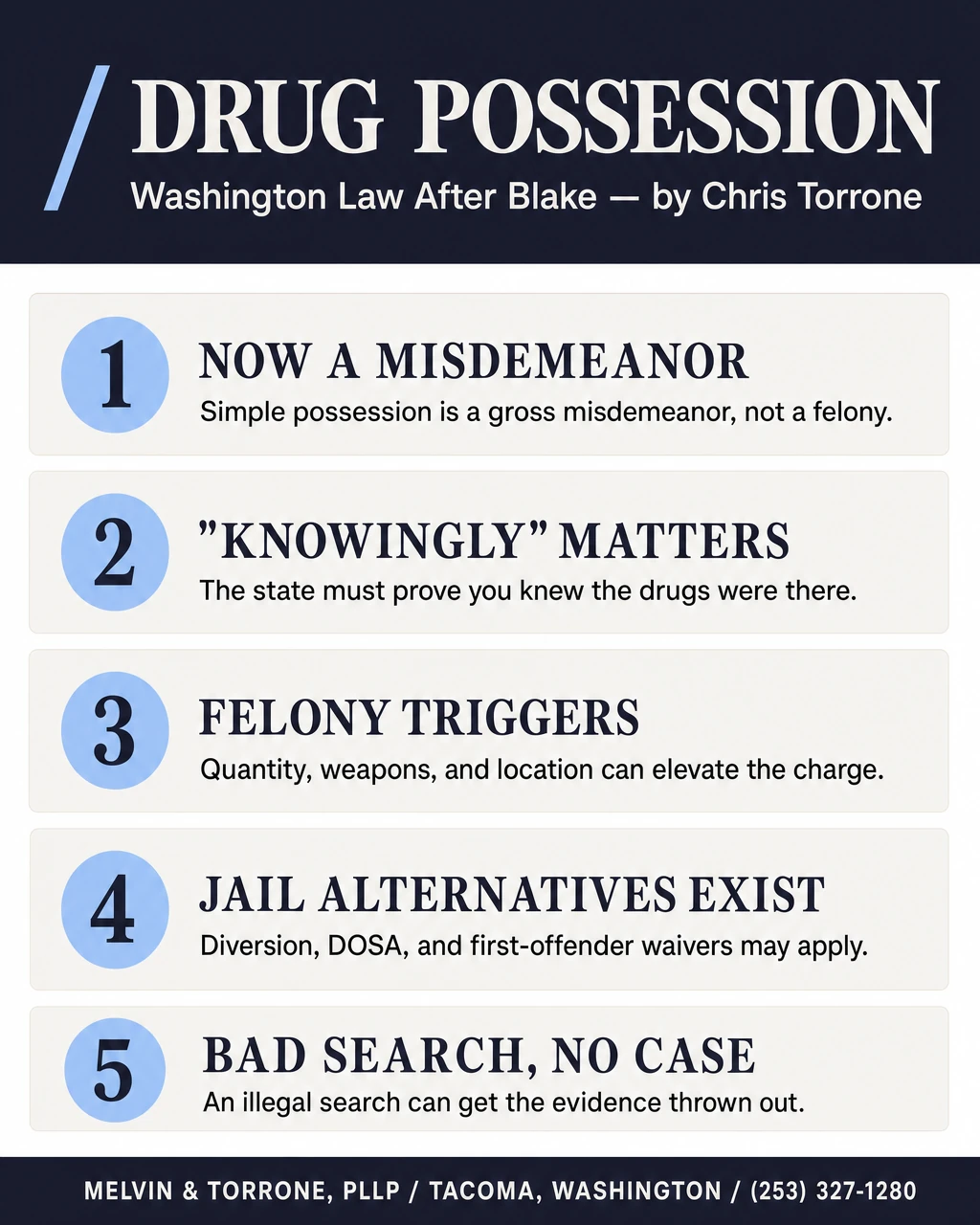
- Simple drug possession is now a gross misdemeanor in Washington, not a felony, but the consequences are still very real and very serious.
- The word “knowingly” is your first line of defense. Prosecutors must now prove you knew the drugs were there.
- Location, quantity, and what else was found nearby can turn a misdemeanor into a felony faster than most people expect.
- Washington offers real alternatives to jail, including pretrial diversion, DOSA, and First Time Offender Waivers. Most people never hear about them without a lawyer.
- A drug conviction follows you beyond the courtroom, affecting your job, your housing, and your financial aid eligibility.
- An illegal search by law enforcement can get your entire case thrown out. Never assume the evidence against you is untouchable.
- Call us before you say anything to anyone. The decisions you make in the first 24 hours shape everything that comes after.
Table of Contents
- Torrone’s Takeaways
- What Actually Changed After the Blake Decision
- How Washington Classifies Controlled Substances Right Now
- Penalties Under Drug Possession Laws in Washington State
- What Prosecutors Must Prove to Convict You
- Situations That Make a Possession Charge Far Worse
- Legal Defenses That Have Won Drug Possession Cases in Washington
- Alternatives to Jail That Washington Courts Actually Offer
- What a Drug Possession Charge Does to Your Life Beyond the Courtroom
- How Melvin & Torrone Fight Drug Possession Charges in Tacoma and Pierce County
- Frequently Asked Questions
- Conclusion
What Actually Changed After the Blake Decision
How Washington Criminalized Drug Possession for Decades
For most of Washington State’s history, simple drug possession was a felony under the Uniform Controlled Substances Act. You didn’t need to know the drugs were there. Unknowing possession still got you convicted. I’ve watched good people lose jobs, housing, and years of their lives to a law that never asked whether they actually knew they had a controlled substance on them.
What State v. Blake Threw Out in 2021
In February 2021, the Washington State Supreme Court struck down the state’s strict liability drug possession law in State v. Blake. The court ruled that the Revised Washington Codes violated due process by requiring no criminal intent whatsoever. Prosecutors no longer had to prove you knowingly possessed anything. Overnight, the law that had sent thousands to prison as felons was gone, and Washington had no replacement ready.
Consider a common situation: a roommate’s prescription drugs turn up in a shared jacket during a traffic stop. Under the old law, that would have been a felony drug charge with no way out. After Blake, the knowledge element can be challenged directly, because the prosecution must now prove the person knew the substance was there.
The Temporary Fix That Left Cities Making It Up as They Went
The Washington State Legislature scrambled after Blake and passed a temporary measure in 2021 making simple possession a misdemeanor. Law enforcement was required to refer people to treatment twice before filing charges. But there was no statewide tracking system, so nobody actually knew who had been referred and who hadn’t. Washington cities and counties ended up writing their own drug laws, creating a confusing patchwork across the state that lasted until mid-2023.
What SB 5536 Finally Settled in 2023
Governor Jay Inslee signed SB 5536, the so-called Blake fix, into law on May 16, 2023, with most provisions taking effect July 1, 2023. The law reclassified simple possession as a gross misdemeanor, punishable by up to 180 days in jail or a $1,000 fine. It also created a pre-trial diversion program and gave the state full authority over drug paraphernalia regulation, ending the local patchwork for good. Drug arrests in Washington nearly doubled in 2024, jumping from 5,022 in 2023 to 10,907, driven largely by methamphetamine offenses, according to the Washington Association of Sheriffs and Police Chiefs’Crime in Washington 2024 report.
How Washington Classifies Controlled Substances Right Now
Schedule I and II Drugs
Washington prosecutes drug offenses under the Uniform Controlled Substances Act, which organizes every controlled substance into five schedules based on abuse potential and medical use. Schedule I drugs, like heroin and LSD, have no accepted medical use and carry the harshest consequences. Schedule II drugs, including fentanyl, morphine, and amphetamines, have high abuse potential but some recognized medical applications. Both categories trigger the most serious drug charges under Washington criminal statutes.
Schedule III, IV, and V Substances and Prescription Drugs
Schedule III, IV, and Schedule V drugs are mostly prescription medications, and possessing them without a valid prescription is still illegal. Schedule III includes anabolic steroids. Schedule IV drugs cover prescription tranquilizers like Valium and flunitrazepam, including its salts, isomers, and salts of isomers. Schedule V covers lower-risk medications. A lawful prescription is your protection. Without one, you’re looking at a real drug possession charge regardless of how ordinary the medication seems.
Consider what happens when a coworker’s Xanax, a Schedule IV drug, turns up in someone’s purse during a workplace search and they have no prescription for it. A defense can be built around lack of knowledge and the absence of any evidence of intentional possession, often well before a charge ever reaches a Pierce County courtroom.
Where Cannabis Stands Under Current Washington Law
Cannabis sits in its own category under Washington State law. Adults 21 and older can legally possess the following amounts under the Washington State Liquor and Cannabis Board’s current rules:
- Up to one ounce of usable cannabis
- Up to 16 ounces of cannabis-infused products in solid form
- Up to 72 ounces in liquid form
- Up to 7 grams of cannabis concentrates
Possession beyond these legal limits can still bring a misdemeanor charge, and minors in possession face separate penalties including a license revocation. Medical marijuana patients operating under qualifying patient status have additional protections under state law.
Penalties Under Drug Possession Laws in Washington State
Gross Misdemeanor Penalties for Simple Possession
Under SB 5536, simple possession of a controlled substance is now a gross misdemeanor in Washington State. That means up to 180 days in jail, a fine of up to $1,000, or both. For a second offense after July 1, 2023, that jail exposure jumps to up to 364 days. These are real consequences that follow you well beyond the courtroom.
When Possession Becomes a Felony Charge
Simple possession is not always where the story ends. Possession of a controlled substance classified as a class C felony, outside of the gross misdemeanor framework, carries up to five years in prison and a $10,000 fine under Washington criminal statutes. Possession with intent to distribute a Schedule I or II narcotic drug under RCW 69.50.401 pushes that into class B felony territory, with up to ten years and a $25,000 fine. The jump from misdemeanor to felony happens faster than most people expect.
What “Possession with Intent to Distribute” Actually Means
Possession with intent to distribute is not just for drug dealers. I’ve seen clients charged with this because of the quantity they had, the presence of small bags, or a scale found nearby. Under Washington law, the prosecution doesn’t need to prove a single sale occurred. Evidence of distribution includes large amounts of cash, multiple phones, or packaging materials. That combination alone can turn a personal use situation into a serious felony drug charge.
A common scenario: someone is stopped near a park with friends, and police find a larger-than-personal-use amount of a Schedule II drug split into small bags. That can lead to a possession-with-intent-to-sell charge under RCW 69.50.401, even with no sale. Aggressively challenging the evidence of distribution is often what stands between a felony and a simple possession charge.
Repeat Offenses Increase Your Sentence
Your offender score is one of the most important numbers in a Washington drug case, and most people have never heard of it. Each prior conviction adds points that directly increase your sentencing range under Washington’s drug offense sentencing grid. In 2024, drug arrests nearly doubled statewide to 10,907 according to the Washington Association of Sheriffs and Police Chiefs, meaning prosecutors are busier and less inclined to go easy on repeat cases. Getting it right the first time protects you from a much harder road later.
Table: Washington State Drug Possession Penalties at a Glance
| Charge Type | Drug Category | Maximum Jail Time | Maximum Fine | Felony Class |
|---|---|---|---|---|
| Gross Misdemeanor | Any controlled substance (simple possession) | 180 days | $1,000 | N/A |
| Gross Misdemeanor (repeat) | Any controlled substance (2+ priors post-July 2023) | 364 days | $1,000 | N/A |
| Class C Felony | Any controlled substance (possession) | 5 years | $10,000 | C |
| Class B Felony | Schedule I or II narcotic, intent to distribute (under 2kg) | 10 years | $25,000 | B |
| Class B Felony | Schedule I or II narcotic, intent to distribute (over 2kg) | 10 years | $100,000+ | B |
| Class B Felony | Amphetamine or methamphetamine, intent to distribute | 10 years | $25,000 | B |
| Misdemeanor | Cannabis, over legal limit up to 40 grams | 90 days | $1,000 | N/A |
| Class C Felony | Cannabis, over 40 grams | 5 years | $10,000 | C |
What Prosecutors Must Prove to Convict You
The Difference Between Actual and Constructive Possession
Most people think drug possession means the drugs were physically on you. That’s actual possession. Constructive possession is broader and more dangerous. It means prosecutors argue you had control over the area where drugs were found, even if they weren’t on your body. I’ve defended clients whose charges stemmed entirely from drugs found in a car they hadn’t driven in days.
The Word “Knowingly” Changed Everything After Blake
Before State v. Blake, Washington criminal statutes required zero proof that you knew the drugs existed. The Blake decision changed that permanently. Now, under the Revised Washington Codes, the prosecution must prove you knowingly possessed a controlled substance. That single word is now your first real line of defense. A peer-reviewed study in Frontiers in Psychiatry concluded that incarceration without proven intent “should be used as a last resort,” a principle Washington’s law now reflects.
Picture someone who borrows a work van from a colleague and gets pulled over for a broken taillight, only for a police report to document methamphetamine found under the passenger seat that they never knew was there. Lack of knowledge is a real defense here, because after Blake the prosecution has to meet the “knowingly” standard, and that can be difficult when someone barely used the vehicle.
What the State Needs to Show About Intent to Distribute
Prosecutors cannot simply point at a quantity of drugs and call it distribution. Under RCW 69.50.401, the state must build a case around evidence of distribution, things like scales, packaging materials, large amounts of cash, or communications suggesting drug sales. We scrutinize every piece of that evidence carefully because one missing element can collapse the entire charge. Drug distribution carries far heavier consequences than simple possession, so this distinction genuinely matters for your future.
Situations That Make a Possession Charge Far Worse
Possession in Drug-Free Zones Near Schools and Parks
Location matters enormously in Washington drug cases, and most people don’t realize it until it’s too late. Possession near schools, parks, public transit stops, or public housing carries enhanced penalties that stack on top of the base charge. In Pierce County, law enforcement actively patrols these areas. In 2024, fentanyl and synthetic opioids accounted for 73% of all drug overdose deaths in Washington, making prosecutors in these zones especially aggressive.
Having a Weapon at the Time of Your Arrest
Something I tell every client from day one is what else is on you matters as much as what drugs are found. A firearm or any other weapon present at the time of a drug arrest can elevate the charge significantly under Washington criminal statutes. Prosecutors use weapon involvement to argue you were operating as a drug distributor, not just a user. That argument alone can push a gross misdemeanor into felony drug charge territory fast.
The following circumstances commonly make a Washington drug possession charge considerably more serious:
- Drugs found within 1,000 feet of a school, park, or public housing
- A firearm or weapon present at the time of arrest
- Large quantities suggesting drug distribution rather than personal use
- Drug paraphernalia present alongside the controlled substance
- Evidence of drug sales on your phone or in written communications
Consider someone pulled over near a community park with a legally owned handgun in the glove compartment and a small amount of a Schedule II drug in a jacket. Two separate aggravating factors hit at once. A key defense move is to separate the weapon issue from the possession charge entirely, arguing no connection between the two, so a distribution theory cannot gain traction.
Prior Convictions and How They Stack the Sentence Against You
Washington uses an offender score system that turns your criminal history into a number, and that number directly controls your sentencing range. Each prior drug offense conviction adds points. More points mean longer recommended sentences under the drug offense sentencing grid. I’ve seen people genuinely shocked at how one old conviction from years ago reshaped the entire landscape of a current case. Getting sound legal guidance early is how you stop that snowball before it rolls.
Legal Defenses That Have Won Drug Possession Cases in Washington
1. Illegal Search and Seizure Violations Under the Fourth Amendment
A legal search is not automatic just because law enforcement found something. If police violated your Fourth Amendment rights during a stop, search, or seizure, everything they found can potentially be thrown out. This is called a motion to suppress evidence, and it is one of the most powerful tools in drug crime defense. I’ve seen cases against clients with significant quantities of controlled substances collapse entirely because the search was conducted illegally.
2. Lack of Knowledge as a Defense Against Possession Charges
Lack of knowledge is not a technicality. It is a legitimate, court-recognized defense that strikes directly at what prosecutors must now prove after State v. Blake. If you genuinely did not know a controlled substance was in your vehicle, home, or belongings, that matters enormously under current Washington criminal statutes. We build these defenses around police reports, witness statements, and the specific circumstances of how and where the drugs were discovered.
Take a rideshare driver whose passenger leaves a backpack in the car, who is then stopped hours later when a controlled substance is found inside a bag they never opened. Rideshare trip logs, passenger records, and phone data can all support a lack of knowledge defense, which strikes directly at what the prosecution must prove after Blake.
3. Entrapment and How Law Enforcement Overreach Gets Cases Thrown Out
Entrapment happens when law enforcement pressures or induces someone into committing a drug offense they would not have otherwise committed. It is more common than people think, particularly in undercover operations targeting drug distribution. Under Washington law, the defense requires showing both that the government initiated the conduct and that you were not predisposed to commit the crime. Some factors which typically support a strong entrapment defense in Washington drug cases are:
- Repeated pressure or persuasion from an undercover officer after an initial refusal
- No prior history of drug offenses or distribution activity
- Communications showing the officer initiated every step of the transaction
- Evidence that the accused expressed reluctance before ultimately complying
4. Valid Prescription and Other Legal Entitlement Defenses
A valid prescription is an absolute defense to possession of prescription drugs in Washington State. If you were carrying opioids, benzodiazepines, or any other Schedule III, Schedule IV, or Schedule V medication that a licensed practitioner prescribed to you, you are legally protected under the Uniform Controlled Substances Act. Qualifying patient status for medical marijuana provides similar protection. I always tell clients to keep prescription documentation accessible because a single piece of paper can make an entire drug charge disappear.
Alternatives to Jail That Washington Courts Actually Offer
The Pretrial Diversion Program Under SB 5536
Not every drug possession case needs to end with a conviction, and that is exactly the point of the pretrial diversion program created under SB 5536. If you are charged with simple possession, you may be eligible to enter a substance abuse treatment program in exchange for having the charge dismissed entirely. The prosecutor must consent, and the judge advises you of its availability at arraignment. Washington’s Recovery Navigator Program now operates in all 39 counties statewide, according to the 2025 SURS Plan progress report submitted to the Washington State Legislature in January 2026.
Drug Offender Sentencing Alternative and How DOSA Works
The Drug Offender Sentencing Alternative, commonly called DOSA, is one of the most underused tools in Washington drug crime defense. It allows qualifying offenders to serve significantly reduced jail time combined with mandatory substance abuse treatment instead of a straight prison sentence. I always encourage clients to ask about DOSA early because eligibility depends on your offender score and the specific drug charges you are facing. Getting into the right program at the right time changes everything about your outcome.
First-Time Offender Waivers
A First Time Offender Waiver can keep you out of jail entirely on a first-offense felony drug charge. The court sets specific conditions, which typically include treatment, community service, and regular check-ins, and you must meet every one of them. I’ve seen this waiver give people a genuine second chance when they committed to the process. It is not automatic, and not everyone qualifies, but for the right client it is an extraordinarily powerful option worth fighting for.
Consider a young student caught with a small quantity of a Schedule I drug at a house party, in their first ever contact with law enforcement. Moving quickly to identify eligibility for a First Time Offender Waiver, before the prosecutor locks in a position, can open the door to a treatment evaluation and community service in place of jail, and to keeping a felony off a young person’s record.
How to Get a Conviction Vacated After Completing Treatment
A conviction does not have to follow you forever under current Washington State law. Under SB 5536, if you complete your treatment program and go two years in the community without a subsequent arrest, charge, or conviction, your possession conviction can be automatically vacated. Vacation removes the conviction from your public record, restoring opportunities in employment, housing, and education that a drug offense would otherwise block. We help clients pursue vacation proactively because most people simply don’t know it’s available to them.
Table: Washington State Drug Diversion and Sentencing Alternatives Compared
| Program | Who Qualifies | What It Requires | Outcome If Completed |
|---|---|---|---|
| Pretrial Diversion (SB 5536) | First-time simple possession defendants | Biopsychosocial assessment, treatment or 120 hours community service for 6 months | Charges dismissed entirely |
| Drug Offender Sentencing Alternative (DOSA) | Qualifying offenders based on offender score and charge type | Reduced jail time combined with mandatory substance abuse treatment | Shorter sentence, treatment-focused |
| First Time Offender Waiver | First-offense felony drug charge defendants | Treatment, community service, regular check-ins, full compliance | Kept out of jail, potential dismissal |
| Recovery Navigator Program (RNP) | Anyone contacted by law enforcement for possession | Referral to case management, treatment, and recovery support services | Diversion from criminal legal system |
| Conviction Vacation (SB 5536) | Anyone who completed treatment with no new arrests for 2 years | Two clean years in the community post-conviction | Conviction removed from public record |
| Drug Court | Eligible defendants with substance use disorders | Regular court appearances, drug testing, treatment participation | Reduced or dismissed charges upon completion |
What a Drug Possession Charge Does to Your Life Beyond the Courtroom
Employment Background Checks and Lost Job Opportunities
A drug conviction shows up on background checks, and most employers in Washington see it before they ever meet you. Licensed professions like nursing, teaching, and contracting have mandatory reporting requirements that can trigger automatic disqualification or license revocation. Washington State’s DSHS automatically disqualifies individuals with certain drug convictions from positions involving unsupervised access to vulnerable adults and children. I’ve watched talented, hardworking people lose careers they spent years building over a single drug possession charge.
Housing Applications and Landlord Screening in Pierce County
Finding housing in Pierce County with a drug conviction on your record is genuinely difficult. Most private landlords run background checks, and a drug offense is one of the most common reasons applications get rejected outright. Federally subsidized housing carries even stricter consequences, as any drug possession charge can result in the loss of federal housing benefits under longstanding federal policy. Losing housing destabilizes everything else in your life, and that ripple effect is something the charge itself never warned you about.
A drug possession charge can threaten a family’s Section 8 housing voucher, because federal housing rules do not account for personal progress. Fighting to get a charge reduced before the housing authority is notified can be what protects a family’s home and keeps children in the same school district.
Federal Financial Aid and What a Drug Conviction Costs Students
Under Section 484(r) of the Higher Education Act of 1998, any conviction for a controlled substance offense makes a student immediately ineligible for federal financial aid. That means no Pell Grants, no subsidized loans, and no federal work-study programs for the duration of the ineligibility period. For a student already stretching financially to attend college in the South Sound, a single drug charge can end an academic career just as effectively as failing out.
How Melvin & Torrone Fight Drug Possession Charges in Tacoma and Pierce County
Deep Local Knowledge of Pierce County Courts and Prosecutors
Pierce County courts have their own rhythms, tendencies, and unwritten rules that only come from years of showing up there. We know the prosecutors, we know the judges, and we know what arguments land in that specific courtroom. That local knowledge is not something you can download overnight, and it makes a measurable difference in how your drug crime defense gets built and delivered.
How We Build a Drug-Possession Defense
We bring years of criminal-defense and DUI experience in the South Sound to every case. What our defense work can look like in practice for drug possession clients:
- Charges reduced from felony to misdemeanor through aggressive evidence challenges
- Cases dismissed entirely after successful motions to suppress illegal searches
- Clients steered into diversion programs that kept convictions off their records
- Repeat offense clients protected from maximum sentencing through careful offender score management
- First-time offenders guided through waivers that preserved their careers and housing
Your First Step Is a Free 30-Minute Consultation
You do not need to figure this out alone, and you should not wait. Book online now or call Melvin & Torrone at (253) 327-1280 to schedule your free 30-minute consultation, Monday through Friday, 8am to 5pm. We are located at 950 Pacific Ave, Suite 720, Tacoma, WA 98402, and we are ready to listen, explain your options clearly, and fight for you.
Frequently Asked Questions
1. Can I lose my driver’s license over a drug possession charge in Washington?
Yes, certain drug convictions in Washington can trigger a driver’s license suspension, particularly for offenders under 21. A criminal defense attorney can help you understand exactly what license consequences your specific charge carries.
2. Does using drugs in a nonpublic place protect me from prosecution under Washington State law?
Not automatically. Washington law prohibits knowing use of a controlled substance in a public place, but possession charges apply regardless of location. Your offender score and the specific circumstances still matter significantly in how prosecutors approach your case.
3. What is the difference between possession and possession with intent to sell?
Simple possession means having a controlled substance for personal use. Possession with intent to sell requires the state to prove distribution intent through evidence like packaging, cash, or drug testing and analyzing equipment found alongside the controlled substance.
4. Can my drug possession charge be elevated because of fentanyl contamination in what I had?
Fentanyl contamination does not reduce your legal exposure and can actually complicate it. If what you possessed tested positive for fentanyl through crime lab analysis, you may face charges based on that specific Schedule II substance regardless of what you believed you had.
5. How does my offender score actually affect my drug possession sentence in Washington?
Your offender score is calculated using prior convictions and directly determines your recommended sentencing range under Washington’s drug offense sentencing grid. A higher score means prosecutors and judges have less flexibility to offer lenient outcomes, making early legal intervention critical.
6. Are hallucinogenic substances treated the same as other drugs under Washington drug schedules?
Hallucinogenic substances like LSD are classified as Schedule I drugs under the Uniform Controlled Substance Act, meaning they carry the harshest penalties with no recognized medical use. Some Washington cities have adopted local decriminalization measures for psilocybin, but state law still treats these as serious drug offenses.
7. Does Washington’s drug paraphernalia regulation apply to harm reduction services like needle exchanges?
Under SB 5536, Washington State fully preempts the entire field of drug paraphernalia regulation statewide, following the precedent set in City of Auburn v. Gauntt. However, Washington cities retain the right to establish and regulate harm reduction services including needle exchange programs under local ordinance.
8. What happens if I have a dual diagnosis involving opioid addiction and a mental health condition when facing drug charges?
Washington courts increasingly recognize co-occurring disorders through drug courts and dual diagnosis programs that pair substance abuse treatment with mental health support. A drug treatment evaluation early in your case can open access to opioid use disorder treatment facilities as an alternative to incarceration.
9. Can recreational cannabis products like cannabis concentrates or cannabis-infused products still get me arrested?
Yes, possessing cannabis concentrates or cannabis-infused products beyond Washington’s legal limits can still result in a misdemeanor charge. Minors in possession of any amount of recreational cannabis face separate penalties, and federal drug conviction risks remain for anyone on federal property or subject to federal jurisdiction.
10. What does RCW 69.50.412 actually cover in Washington State drug law?
RCW 69.50.412 governs drug manufacture and the use of drug testing and analyzing equipment in connection with controlled substances. Violations under this statute carry their own penalties separate from simple possession and can significantly complicate an otherwise straightforward drug crime defense strategy.
Conclusion
Drug possession laws in Washington State are complicated, fast-changing, and unforgiving to people who face them without the right support. At Melvin & Torrone, we have spent decades fighting for people in Pierce County and the South Sound who felt like the system was stacked against them. We understand what you are facing because we have seen it firsthand. Your situation deserves a personalized plan, not a generic response.
Book your free consultation today and let’s build your defense together.
Each case is unique. Past results do not guarantee future outcomes. This article provides legal information, not legal advice. Reading this article does not create an attorney-client relationship with Melvin & Torrone, PLLP.

Chris Torrone
Founding Partner, Melvin & Torrone PLLP
Chris Torrone is a dedicated advocate for clients facing family crises and criminal charges. With 20 years of experience practicing in Pierce County courts, Chris has built a reputation for meticulous case preparation and creative problem-solving in high-stakes litigation.