
CPS and Criminal Charges: Navigating Both Cases
Yes, you can face CPS and criminal charges at the same time, and yes, both cases can affect each other in ways that catch most parents completely off guard. After more than 20 years of fighting for families in Pierce County, I can tell you that the parents who get hurt the most are the ones who treated these two cases as separate problems. They are not. What you say to a CPS investigator can walk straight into your criminal case. What happens in family court can shape your criminal defense strategy.
Let’s talk about how to protect yourself on both fronts.
Torrone’s Takeaways
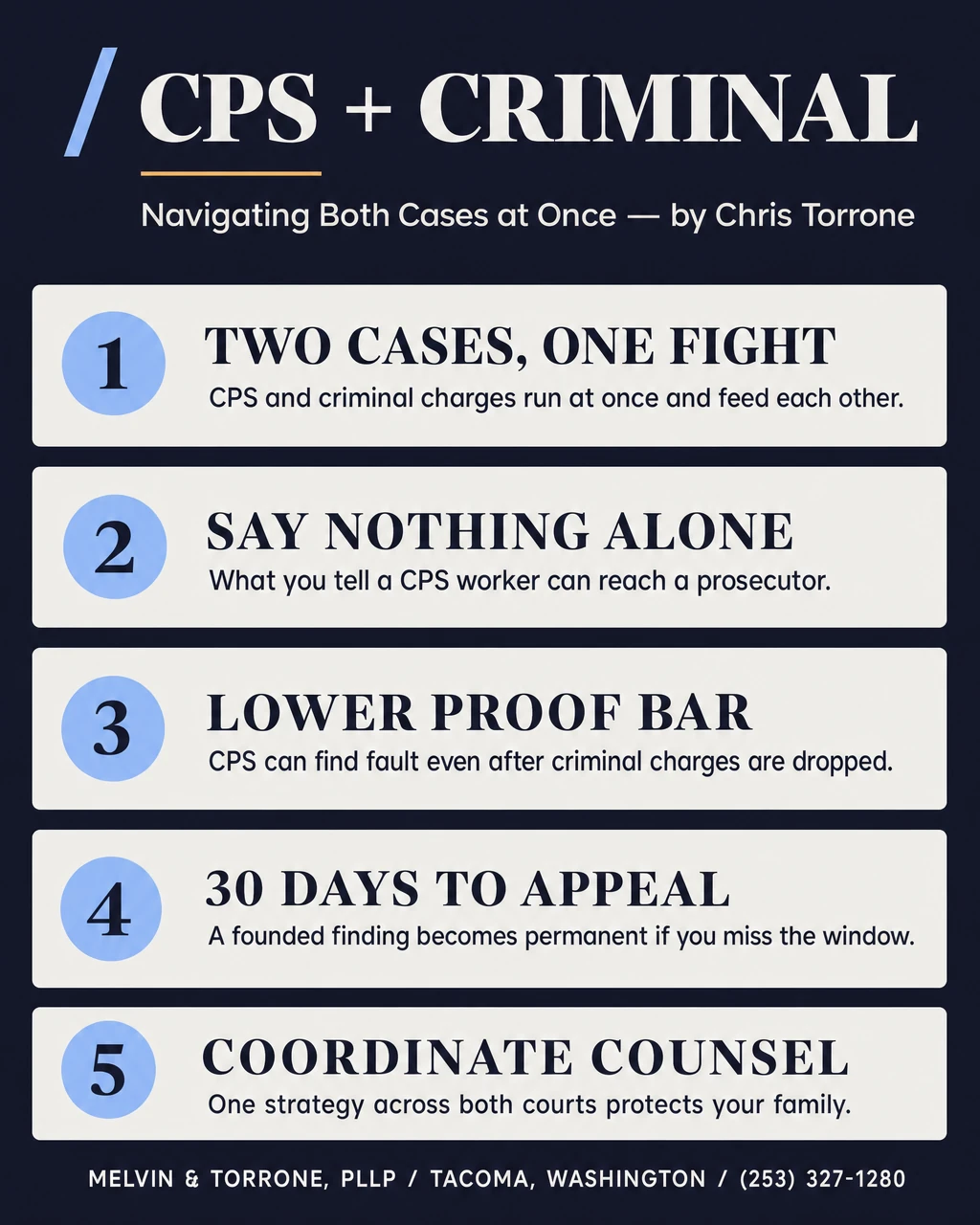
- CPS and criminal cases run simultaneously and feed each other. Treat them as one fight, not two separate problems.
- Never talk to a CPS investigator without a lawyer present, no matter how innocent you feel.
- A founded CPS finding can damage your criminal defense even if no charges are ever filed.
- You have exactly 30 days to appeal a founded finding in Washington State. Miss that window and the damage compounds.
- Dropped criminal charges do not close your CPS case. The two systems run on completely different evidence standards.
- Your children can be temporarily removed before anything is proven. Early legal representation is your fastest path to getting them home.
- One attorney for both cases is possible, but coordinated representation across both proceedings is always the stronger play.
Table of Contents
- Torrone’s Takeaways
- How CPS and Criminal Cases Work at the Same Time
- What Triggers a CPS Case When You Already Have Criminal Charges
- How to Handle CPS and Criminal Charges Without Making Things Worse
- How the Evidence Standards Differ Between a CPS Case and a Criminal Case
- What Washington State CPS Can and Cannot Do During an Investigation
- How a Founded CPS Finding Can Damage Your Criminal Defense
- Protecting Parental Rights When CPS and Criminal Charges Overlap
- What Happens After Both Cases Are Closed
- How Melvin & Torrone, PLLP Defends Families Facing CPS and Criminal Charges
- Frequently Asked Questions
- Conclusion
How CPS and Criminal Cases Work at the Same Time
CPS Is a Civil Case, Not a Criminal One
CPS operates entirely within the civil court system, not the criminal one. Its legal mandate is to assess whether a child is safe at home, not to punish a parent or caregiver. The agency asks “is this child safe right now?” while a criminal investigation asks “did this person commit a crime?” Both questions can be triggered by the exact same incident, on the exact same day, running simultaneously in two completely separate courtrooms with two completely different sets of rules. I have seen parents walk into a CPS home visit completely unaware that a criminal investigation was already underway, and that gap in awareness cost them dearly.
When Law Enforcement Gets Pulled In
In Washington State, when CPS receives a report involving suspected abuse or neglect, they routinely coordinate with local law enforcement under the County Child Abuse, Fatality, and Criminal Investigations Protocols. A 911 call, a concerned mandated reporter, or even a routine home visit observation can be enough to trigger a parallel criminal investigation by law enforcement.
Suddenly you are not managing one legal problem. You are managing two, each governed by its own procedures, its own timelines, and its own potential consequences for your freedom and your family. The criminal justice system and the child welfare system may share information freely between them, even when you had no idea that sharing was happening.
How the Two Cases Feed Each Other
What you say to a CPS worker can end up in front of a criminal prosecutor. A founded CPS finding can be introduced as evidence in criminal court. A criminal history background check can directly shape how a dependency action unfolds in family court. In Federal Fiscal Year 2023, U.S. child protective services agencies received an estimated 4,399,000 referrals involving roughly 7.78 million children, and a significant portion of those cases ran alongside active criminal investigations, according to the U.S. Department of Health and Human Services Child Maltreatment 2023 report. The two systems are legally separate but practically inseparable, and anyone who treats them as unrelated problems will likely pay for that mistake twice.
A common pattern looks like this: a domestic violence call brings both a criminal charge and a CPS investigation to a parent’s door within 48 hours. The parent speaks freely to the CPS worker before anyone explains that the two cases are connected, and those statements later surface in the criminal case. It is a hard lesson in how fast one case bleeds into the other.
What Triggers a CPS Case When You Already Have Criminal Charges
Domestic Violence Charges That Involved Your Kids
A domestic violence charge does not have to be directed at your child to pull CPS into your life. If your kids were present, nearby, or even just in the home during the incident, that is often enough. Law enforcement routinely notifies CPS after domestic violence calls where children live in the household. Research published by the Office of Justice Programs found that domestic violence between adults is present in at least one-third of families already involved with child protective services.
DUI With a Child in the Vehicle
A DUI with a child in the vehicle is one of the fastest ways to face CPS and criminal charges at the same time. Most states treat this as child endangerment, which triggers an automatic CPS referral alongside the criminal charge. In Washington, law enforcement is not just permitted to notify CPS in this situation, it is expected. I have worked with Pierce County parents who were blindsided by a dependency action they never saw coming after what they assumed was a straightforward DUI case.
Consider a typical scenario: a parent is pulled over with a child in the backseat over the weekend, and by the start of the next week CPS has already made contact with the child’s school. Many parents have no idea the two cases are connected until the school calls them.
Drug Possession, Assault, and Other Charges That Put CPS on Alert
Several criminal charges commonly trigger CPS involvement even when no child was directly harmed. These are the most frequent ones we see in Pierce County cases:
- Drug possession, particularly when children were present in the home or vehicle
- Assault charges, especially when the incident happened at the family residence
- Theft or burglary, when children were present during the alleged offense
- Driving offenses, including reckless driving with a minor passenger
- Neglect-related charges, which almost always run parallel to a CPS investigation
Any criminal charge that puts a child’s environment in question can open a juvenile dependency case. The child protective service worker assigned to your case may have already read the police report before they knock on your door.
Table: Which Criminal Charges Most Commonly Trigger a CPS Investigation in Washington State
| Criminal Charge | Likelihood of CPS Involvement | Why CPS Gets Called |
|---|---|---|
| Domestic Violence | Very High | Children present or living in the home |
| DUI With a Child in the Vehicle | Near Certain | Automatic referral by law enforcement |
| Drug Possession at Home | High | Children’s environment placed at risk |
| Physical Assault at Residence | High | Children’s safety directly in question |
| Child Endangerment | Certain | CPS involvement is built into the charge |
| Neglect-Related Offenses | Certain | Directly triggers dependency investigation |
| Burglary or Theft With Children Present | Moderate to High | Children’s welfare and stability questioned |
| Reckless Driving With Minor Passenger | Moderate to High | Child safety concern flagged by law enforcement |
| Violation of a Protective Order | High | Existing family court involvement escalates quickly |
| Drug Manufacturing or Distribution at Home | Very High | Immediate environment deemed unsafe for children |
How to Handle CPS and Criminal Charges Without Making Things Worse
Stop Talking to CPS Without a Lawyer Present
I know this feels counterintuitive. You are innocent, you have nothing to hide, and you want to cooperate. But talking to a CPS investigator without legal representation is one of the most common mistakes I see parents make. A CPS worker is not your ally in a criminal investigation. Everything you say gets documented, and that documentation can travel straight into the hands of a criminal prosecutor before you even know charges are being considered.
What You Say to CPS Can Show Up in Criminal Court
As Josh Gupta-Kagan, founder of the Family Defense Clinic at Columbia Law School, put it plainly: “You get more due process protections when facing a couple months in jail than you do when you are facing losing your kids forever.” That gap in protection is exactly why your Fifth Amendment right against self-incrimination matters here. CPS cases are civil proceedings, but the facts they uncover feed directly into the criminal justice system. A statement that sounds reasonable in a family court context can look very different when a prosecutor reads it aloud in a criminal courtroom.
Parents who sit down with a CPS investigator without an attorney present often answer questions they assume are routine, only to learn later that those answers were forwarded to the prosecutor’s office as part of an active criminal investigation. Getting ahead of that damage takes significantly more work than preventing it would have.
Your Right to Know the Exact Allegations Against You
Most parents do not realize this, but federal law requires CPS to tell you the specific allegations against you at the very first point of contact. Vague terms like “neglect” or “abuse” are not specific enough to meet that legal standard. You are entitled to know exactly what you are accused of, and if a CPS worker refuses to tell you, that is something your defense attorney needs to hear about immediately. Do not let anyone investigate you without first telling you what the investigation is actually about.
How the Evidence Standards Differ Between a CPS Case and a Criminal Case
Preponderance of Evidence vs. Beyond a Reasonable Doubt
These two standards sound technical, but the difference between them is enormous and it directly affects your family. In a criminal case, the prosecution must prove guilt beyond a reasonable doubt, the highest standard in the legal system. In a CPS case, the standard is preponderance of evidence, which simply means “more likely than not.”
A peer-reviewed study in the Journal of Family Violence analyzed 223,785 CPS cases of alleged sexual abuse and found that only 24.5% were substantiated under that lower standard, published in Springer Nature in October 2024. That means CPS can act against you with far less proof than a criminal court requires.
Why CPS Can Find You at Fault Even When Criminal Charges Are Dropped
This surprises nearly every parent I talk to, so I want to be direct about it. A prosecutor dropping your criminal charges does not close your CPS case. The two systems run on different tracks with different standards, and a finding in one does not erase a finding in the other. CPS can determine by a preponderance of evidence that abuse or neglect occurred even when a criminal court found insufficient evidence to convict. I have seen parents walk out of criminal court relieved, only to face a dependency action in juvenile court the following week.
Picture a parent whose criminal charges are fully dismissed after the prosecutor determines there is not enough evidence to proceed. Weeks later, DCYF issues a founded finding based on the same allegations, using the lower civil standard. Many parents have no idea that is even legally possible until it surfaces on a background check, sometimes when applying to volunteer at a child’s school.
How a “Reason to Believe” Finding Affects Your Family
In Washington State, when CPS concludes there is reason to believe abuse or neglect occurred, the consequences start immediately and reach further than most people expect. That finding can be used as evidence in your criminal case, influence custody arrangements in family court, and appear on criminal history background checks tied to your name.
It can affect your ability to work with children, obtain certain professional licenses, and even determine where your kids are placed if removal becomes part of a dependency action. A “reason to believe” finding is not a conviction, but in practical terms, it carries real weight in multiple legal arenas at the same time.
Table: CPS vs. Criminal Case: Side-by-Side Comparison
| Factor | CPS Case | Criminal Case |
|---|---|---|
| Court System | Civil / Family Court | Criminal Court |
| Standard of Proof | Preponderance of Evidence (more likely than not) | Beyond a Reasonable Doubt |
| Goal | Child safety and family preservation | Determine guilt and impose punishment |
| Who Investigates | DCYF Caseworker | Law Enforcement |
| Can You Lose Without a Conviction | Yes | No |
| Right to Attorney | Limited in Washington State | Guaranteed by Sixth Amendment |
| Timeline | 60 days for investigation under Washington law | Varies widely by charge severity |
| Can Findings Be Shared | Yes, with prosecutors and law enforcement | Yes, with CPS and family court |
| Appeal Window | 30 days from founded finding letter | Varies by court and charge type |
| Long-Term Record Impact | Founded finding stays on background checks | Criminal conviction stays on criminal record |
What Washington State CPS Can and Cannot Do During an Investigation
Interviewing Your Children Without Your Permission
This one shocks almost every parent I work with, so let me be clear about it upfront. In Washington State, DCYF caseworkers have the legal authority to interview your children without your permission and without notifying you first. These interviews can happen at your child’s school, daycare, or even at home, and the caseworker is specifically required to conduct them outside your presence. Your child also has the right to request a trusted adult be present, but that adult cannot be you as the parent under investigation.
Entering Your Home and What Requires a Court Order
A CPS investigator does not have an automatic right to enter your home. Without your consent or a court order, they cannot come inside. You have the right to politely decline entry and request that they return with proper legal authorization. That said, if a caseworker believes a child is in immediate danger, Washington law allows emergency entry without a court order, which is exactly why having an attorney on call from the moment CPS makes contact matters so much.
CPS investigators are bound by clear rules about what they can and cannot do during a home visit. Look at this quick breakdown:
- They can photograph your children as part of the investigation
- They can speak with neighbors, teachers, and relatives without your knowledge
- They can request access to medical and school records
- They cannot enter your home without consent or a court order in non-emergency situations
- They cannot remove your child without either your agreement or a court order, except in genuine emergencies
The 60-Day Investigation Window Under Washington Law
Washington State DCYF policy requires child welfare investigators to complete CPS investigations within 60 days of the date the allegations were reported, according to DCYF Policy 2331. That window can extend if law enforcement determines additional time is needed under the County Child Abuse, Fatality, and Criminal Investigations Protocols. Sixty days sounds like a long time, but it moves fast when you are also managing a parallel criminal case with its own deadlines and hearings.
It is common for a parent to wait out a CPS investigation that has been open for weeks with no updates, assuming silence means progress. Often a concurrent criminal investigation has extended the timeline, and decisions are being made about the children while the parent has no clear sense of where the case stands. Getting informed and represented in both proceedings at once can change the outcome significantly.
How a Founded CPS Finding Can Damage Your Criminal Defense
CPS Records Get Shared With Prosecutors
Most parents assume CPS records stay inside the family court system. They do not. In Washington State, information gathered during a CPS investigation, including your statements, home visit observations, and case findings, can be shared directly with law enforcement and prosecutors handling your criminal case. A founded finding of abuse or neglect becomes part of your record and can surface as evidence in criminal court proceedings, dependency hearings, and future criminal history background checks tied to your name.
The 30-Day Appeal Window You Cannot Miss in Washington
A parent juggling criminal case hearings might receive a founded finding letter from DCYF and set it aside, planning to deal with it the following week. The 30-day appeal window under RCW 26.44.125 can close before they act. That one missed deadline can mean the founded finding stays on the record and is later used against the parent in a bond conditions hearing.
Under Washington law, you have exactly 30 days from receiving your founded finding letter to submit a written appeal request. Miss that window and it becomes extremely difficult to remove the finding from your record. That finding then appears on background checks, influences custody decisions in family court, and can be introduced as evidence in your criminal case. Thirty days is not much time when you are already managing a criminal defense.
A Dependency Action Escalates Your Legal Exposure
A dependency action is when DCYF petitions the juvenile court to formally declare your child dependent, meaning in need of state protection. This is the step that can lead to your children being placed in foster care and your parental rights being put on a legal timeline. A dependency action running alongside a criminal case creates compounding legal exposure because findings in juvenile court can directly inform decisions in criminal court and vice versa. Getting ahead of a dependency petition early is one of the most important moves you can make when CPS and criminal charges overlap.
Protecting Parental Rights When CPS and Criminal Charges Overlap
Why You May Need Two Separate Attorneys
One attorney handling both a CPS case and a criminal case simultaneously is possible, but it requires someone with deep experience in both systems. More often, the smartest move is having two attorneys working in close coordination, one focused on the dependency action in family court and one focused on your criminal defense strategy. The reason is straightforward: the goals of each case can sometimes pull in opposite directions, and what helps you in one courtroom can hurt you in the other without careful coordination between your legal team.
Building a Defense That Covers Both Cases at Once
Parents investigated separately by CPS and law enforcement after a neglect allegation sometimes hire one attorney for the criminal side but go without representation in the dependency proceeding. Statements made during an unrepresented CPS hearing can complicate the criminal defense significantly. A coordinated defense from day one looks very different.
An estimated 26% to 37% of U.S. children will be the subject of a CPS investigation before age 18, according to research published in Child Abuse and Neglect via PMC. For parents already facing criminal charges, that number underscores how quickly child welfare involvement can become a long-term pattern without a strong, coordinated defense strategy. Your criminal defense attorney and your family law attorney need to be talking to each other regularly, sharing strategy, and making sure neither case is being sacrificed for the other.
How CPS and Criminal Charges Affect Custody Arrangements
Custody is often the first casualty when CPS and criminal charges collide. A CPS investigation alone can trigger emergency protective orders and temporary changes to existing custody arrangements before any court has made a final determination. A criminal charge, particularly one involving domestic violence or child endangerment, adds another layer of legal pressure that family court judges take seriously. I have seen good parents lose temporary custody not because of what a court decided, but because no one was in their corner fast enough to respond when both cases moved at once.
What Happens After Both Cases Are Closed
Founded CPS Finding Stays on Your Record
Closing a CPS case does not erase a founded finding. In Washington State, a founded finding of child abuse or neglect stays on your record and appears on background checks even after your case is fully closed, even if your children were never removed, and even if no criminal charges were ever filed. It can affect employment in any field involving children or vulnerable adults, influence future custody proceedings, and surface in any new CPS investigation involving your family.
Clearing Your Name After an Unfounded Investigation in Washington
An unfounded CPS finding is not automatically wiped from existence the moment the case closes. Under Washington law, unfounded and inconclusive reports must be destroyed after six years, unless there is a prior or later founded finding involving the same family, per RCW 26.44.031. If your investigation was closed as unfounded, document everything and keep records of that outcome for yourself, because future investigations can reference prior history even when prior findings went nowhere.
A prior unfounded CPS report can be referenced during a new investigation years later, even when the original case was closed with no action taken, and parents are often never told the report is still retained on file. That kind of prior reference can quietly shape how a new caseworker approaches a family from the very first home visit.
Getting Your Children Home After a Dependency Action
Reunification after a dependency action requires demonstrating to the juvenile court that the conditions that led to removal have been meaningfully addressed. Washington State DCYF’s stated goal is always to reunify families when it is safe to do so, but that process involves court hearings, compliance with a service plan, and consistent engagement with caseworkers over time. The parents who get their children home fastest are almost always the ones who had legal representation guiding them through every step of the dependency process from the beginning.
How Melvin & Torrone, PLLP Defends Families Facing CPS and Criminal Charges
A Firm That Fights on Both Fronts in Pierce County
Most law firms handle either family law or criminal defense. We handle both, and we handle them together. At Melvin & Torrone, PLLP, we have spent decades representing Pierce County families who are facing CPS investigations, criminal charges, or both at the same time. We know how the two systems interact in local courts, we know the prosecutors, and we know exactly what it takes to build a defense strategy that protects you on every front simultaneously.
How this practice works for our clients:
- Immediate legal representation at CPS home visits and interviews
- Coordinated defense strategy across both the dependency and criminal proceedings
- Direct communication between your family law and criminal defense representation
- Aggressive response to founded findings, including appeals within Washington’s strict 30-day window
- Ongoing guidance through every court date, hearing, and DCYF interaction
Why the Dual-Practice Team Matters When CPS and Criminal Charges Overlap
Experience matters when your family is on the line. Chris Torrone focuses on CPS and family-law matters and Jordan Foster on criminal defense and DUI, so when a CPS case and a criminal charge overlap, one team handles both. When you work with Melvin & Torrone, PLLP, you are not getting one experienced attorney watching one case. You are getting a team watching both, making sure nothing slips through the gap between your CPS case and your criminal defense.
Talk to a Tacoma Attorney Before Your Next Court Date
If you are facing CPS and criminal charges at the same time in Pierce County or anywhere in the South Sound, the worst move you can make is waiting. Every hearing, every CPS home visit, and every conversation with a caseworker is a moment where the right legal guidance can change your outcome. We offer a free 30-minute consultation which you can book right now by filling out this quick form online. We are available Monday through Friday from 8am to 5pm at (253) 327-1280. Our office is located at 950 Pacific Ave, Suite 720, Tacoma, WA 98402. You will be known by your name here, not a case number, and we will fight for you on both fronts from the very first conversation.
Frequently Asked Questions
1. Can CPS remove my children while my criminal case is still pending?
Yes. CPS operates independently of the criminal justice system and can pursue a juvenile dependency case and emergency protective order based on its own civil standard of proof, regardless of where your criminal case stands.
2. Does a criminal charge automatically trigger a CPS investigation in Washington State?
Not automatically, but charges involving domestic violence, drug crimes, or child endangerment almost always prompt law enforcement to notify CPS. Once CPS receives that referral, an investigation typically opens within days.
3. What is the difference between a CPS investigation and what a Forensic Interviewer does?
A Forensic Interviewer is a trained specialist, often operating through a Child Advocacy Center, who conducts structured interviews with children separate from the standard CPS process. Their findings carry significant weight in both dependency hearings and criminal proceedings.
4. Can CPS allegations from my case be used against me in a magistrate hearing or at arraignment?
Yes. CPS records and founded findings can surface during a magistrate hearing when bond conditions are being set. Prosecutors sometimes reference child welfare involvement to argue for stricter conditions or higher bond amounts.
5. How long do CPS records stay on file in Washington State?
Founded findings remain on your record indefinitely and appear on background checks until successfully appealed. Unfounded reports are generally destroyed after six years under Washington’s Record Retention and Disposition Schedule, unless a founded finding exists in the same family’s history.
6. If my CPS case involves a Multidisciplinary Team, does that mean criminal charges are coming?
A Multidisciplinary Team investigation, which brings together CPS, law enforcement, a Forensic Interviewer, a Behavioral Health Clinician, and sometimes a Crisis Center Advocate, signals that your case is being treated seriously on multiple fronts. Criminal charges are not guaranteed, but the involvement of that team means you need criminal defense attorneys involved immediately.
7. Can I lose custody of my children based solely on CPS allegations before anything is proven?
Yes, temporarily. Washington courts can issue an emergency protective order or civil protective order removing your children from the home before a full hearing takes place. Your legal rights in this situation depend heavily on having immediate legal representation to respond at the earliest possible hearing.
8. Does a founded CPS finding affect my criminal case the same way a prior conviction does?
It is not treated identically to a criminal conviction, but it carries real legal consequences. A founded finding can influence sentencing recommendations, affect bond conditions, and be referenced in criminal proceedings as evidence of a pattern of behavior involving your children.
9. I was cleared of criminal charges. Why is my juvenile dependency case still open?
The juvenile court system operates on a preponderance of evidence standard, which is significantly lower than the beyond a reasonable doubt standard used in criminal court. A Family Support Specialist or caseworker can continue pursuing dependency based on the same facts that a criminal court found insufficient to convict.
10. What should I do if I receive a cross court docket number connecting my CPS case to my criminal case?
Contact a defense attorney immediately. A cross court docket number means the two cases are being tracked together by the court system, and decisions in one proceeding are actively influencing the other. This is a signal that your legal battle requires coordinated representation across both cases without delay.
Conclusion
Facing CPS and criminal charges at the same time is one of the most overwhelming legal situations a parent can walk into. The good news is that you do not have to figure it out alone. At Melvin & Torrone, PLLP, we have spent decades fighting for Pierce County families on both fronts simultaneously, and we know exactly how to build a strategy that protects your freedom and keeps your family together. Let’s build your plan today.
Book Your Free Consultation.
Each case is unique. Past results do not guarantee future outcomes. This article provides legal information, not legal advice. Reading this article does not create an attorney-client relationship with Melvin & Torrone, PLLP.

Chris Torrone
Founding Partner, Melvin & Torrone PLLP
Chris Torrone is a dedicated advocate for clients facing family crises and criminal charges. With 20 years of experience practicing in Pierce County courts, Chris has built a reputation for meticulous case preparation and creative problem-solving in high-stakes litigation.