
What Happens at a CPS Fact-Finding Hearing in Washington?
At a CPS fact-finding hearing, a judge reviews the evidence from both sides and decides whether the abuse or neglect allegations in the dependency petition are true. That single ruling shapes everything that comes next for your family.
We have sat beside parents in dependency court who had no idea what was walking through that courtroom door. After 20 years of fighting these cases in Pierce County, we can tell you this much: the families who come prepared are in a far stronger position. The ones who show up confused lose ground they rarely get back.
Let me break down exactly what happens at a CPS fact-finding hearing, step by step, in plain language.
Torrone’s Takeaways
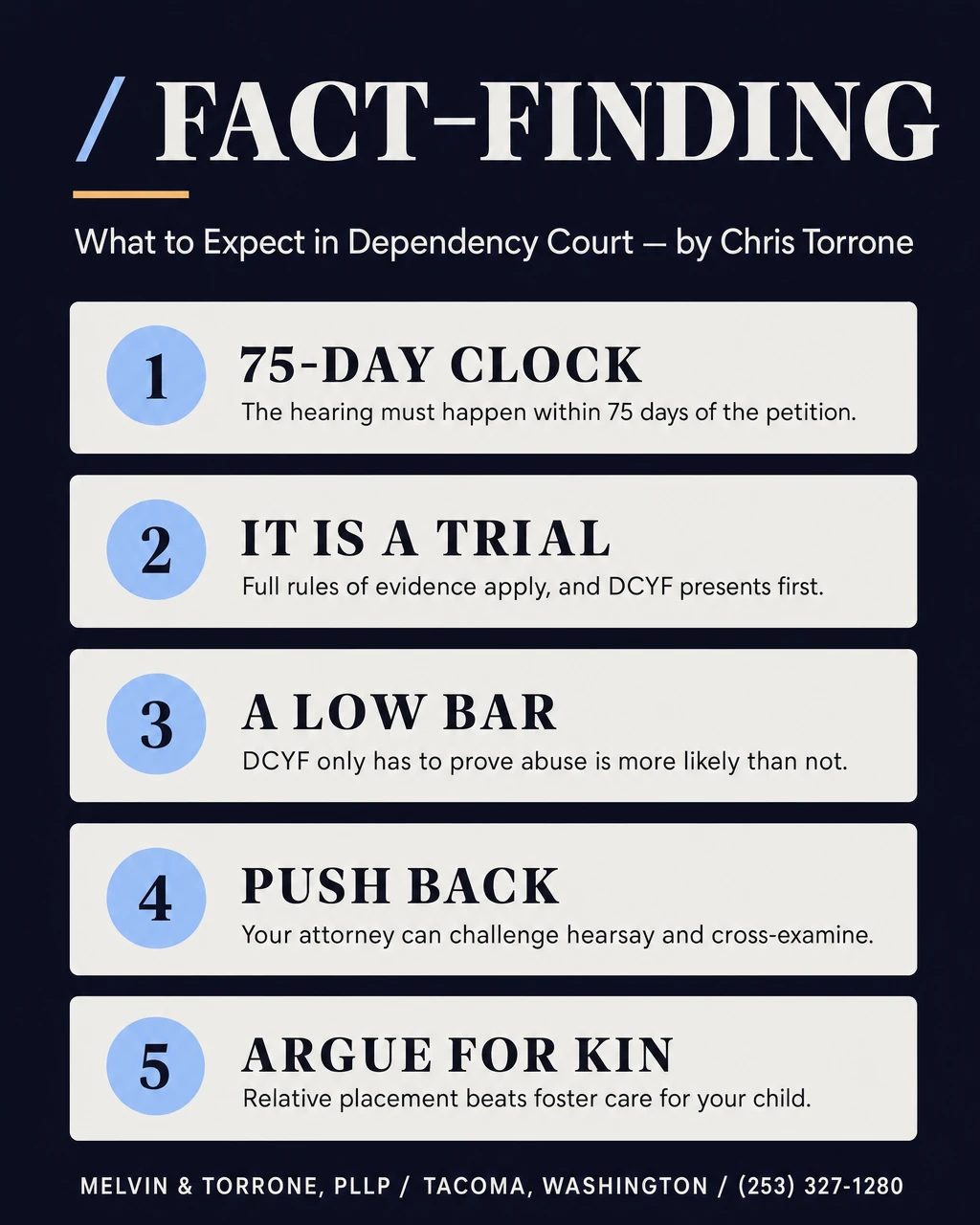
- That 75-day clock starts the moment DCYF files the dependency petition.
- The fact-finding hearing is a real trial with real rules of evidence. Treat it that way.
- DCYF goes first and comes prepared. You should too.
- Preponderance of the evidence is a low bar. Do not hand them an easy win.
- A founded finding follows you long after the courtroom empties. Fight it at the source.
- Kinship placement beats foster care every time. Your attorney should be arguing for it from day one.
- Preparation decides fact-finding hearings, and we prepare harder than the other side.
Table of Contents
- Torrone’s Takeaways
- How a CPS Fact-Finding Hearing Fits Into the Dependency Process
- What Actually Happens at a CPS Fact-Finding Hearing
- What Evidence Gets Introduced and What Gets Excluded
- The Burden of Proof Standard Most Parents Get Wrong
- What Happens at a CPS Fact-Finding Hearing If You Lose
- The Agreed Order of Dependency Option Parents Rarely Hear About
- Your Parental Rights During a Fact-Finding Hearing in Washington
- 3 Mistakes Parents Make Before and During the Hearing
- How Melvin & Torrone Fights for Pierce County Families at Fact-Finding Hearings
- Frequently Asked Questions
- Conclusion
How a CPS Fact-Finding Hearing Fits Into the Dependency Process
The Hearings That Come Before the Fact-Finding
Think of the dependency process as a series of escalating decisions, each one building on the last. It starts the moment DCYF removes a child or files a dependency petition. Before you ever reach the fact-finding hearing, you will sit through a 72-hour shelter care hearing and at least one 30-day review hearing. Each of those earlier court proceedings shapes the battlefield you walk into at the fact-finding.
When the 75-Day Clock Starts After the Dependency Petition
Under Washington State law, specifically RCW 13.34.110, a fact-finding hearing must be held within 75 days of filing the dependency petition. That clock starts the moment DCYF files paperwork with the court. In 2025, Washington’s DCYF received 122,222 reports of abuse and neglect, with 43,311 screened in for a response, according to the Washington State Department of Children, Youth, and Families. Seventy-five days sounds like a long time. It is not. We have seen families lose precious ground simply because they did not start building their defense on day one.
How the Fact-Finding Differs From the 72-Hour Shelter Care Hearing
It is common for a parent whose children are removed at the end of a week to sit through a shelter care hearing without a lawyer before the next business day, assuming it is just a formality. It is not. That early hearing sets the tone for everything that follows, including the fact-finding date.
The 72-hour shelter care hearing is fast, focused, and limited in scope. A family court judge simply decides whether your child stays home or goes into out-of-home care while the case moves forward. The fact-finding hearing is an entirely different legal proceeding. Here, the court applies the rules of evidence, both sides present witness testimony and documentary proof, and the judge determines whether the abuse allegations in the dependency petition are actually true. The shelter care hearing decides where your child sleeps tonight. The fact-finding hearing decides your family’s future.
Table: Washington State Dependency Court Hearing Timeline at a Glance
| Hearing Type | When It Happens | What the Court Decides |
|---|---|---|
| 72-Hour Shelter Care Hearing | Within 72 hours of child removal | Whether your child stays home or enters out-of-home care temporarily |
| 30-Day Review Hearing | 30 days after shelter care | Whether conditions have changed and what services are needed |
| Fact-Finding Hearing | Within 75 days of dependency petition filing | Whether abuse or neglect allegations are proven by a preponderance of evidence |
| Dispositional Hearing | Immediately after fact-finding, or within 14 days | Case plan requirements, placement, and reunification conditions |
| Review Hearings | Every 6 months while child remains in care | Progress on case plan and whether child can return home |
| Permanency Planning Hearing | Within 9 to 12 months of out-of-home placement | Long-term permanency plan for the child |
| Termination of Parental Rights Hearing | After 15 of 22 months in out-of-home care if reunification fails | Whether parental rights are permanently terminated |
What Actually Happens at a CPS Fact-Finding Hearing
How DCYF Presents Its Case Against You
DCYF goes first, and they come prepared. Their social worker takes the witness stand and walks the court through their CPS investigation findings. They present police reports, medical records, GP reports, photographs, and any other documentary evidence gathered during the investigation. Their attorney then calls additional witnesses, which may include teachers, doctors, or other professionals who had contact with your child. You sit across the room and listen to all of it before you get a single word in.
How Parents Get to Tell Their Side
In federal fiscal year 2023, approximately 3.1 million children received a Child Protective Services response nationwide, according to the U.S. Department of Health and Human Services Child Maltreatment 2023 report. Behind every one of those numbers is a parent who deserved a fair chance to respond. At the fact-finding hearing, that chance comes through your own oral evidence, your witnesses, and any documentary proof your attorney introduces.
Many parents have no idea they are even allowed to bring witnesses. You are. Your attorney cross-examines every DCYF witness, challenges the evidence evaluation, and presents your side of the story directly to the family court judge.
What the Judge Is Deciding by the End of the Day
By the close of the fact-finding hearing, the judge is answering one specific legal question. The court considers the following possible outcomes:
- Petition dismissed: DCYF failed to meet its burden of proof, and your child returns home.
- Dependency established: The court finds the abuse allegations proven and schedules a dispositional hearing within 14 days.
- Continued hearing: The judge needs additional time or evidence before issuing a ruling.
That dispositional hearing, which follows quickly after, is where the case plan and out-of-home care decisions get made. The fact-finding ruling is the hinge point everything else swings on.
What Evidence Gets Introduced and What Gets Excluded
Records, Photos, and Testimony DCYF Can Use
DCYF can bring a lot into that courtroom, and they will. Their evidence typically includes medical records, hospital reports, GP reports, photographs of injuries or home conditions, police reports, and written statements from their social worker. They can also call teachers, counselors, and child advocacy center staff as witnesses. According to HHS Child Maltreatment 2023 data, three quarters of all maltreated children were found to have suffered neglect rather than physical abuse, meaning much of DCYF’s evidence in neglect cases is often circumstantial, which makes it challengeable.
Evidence Parents Can Bring to Push Back
You have just as much right to introduce evidence as DCYF does. When allegations are triggered by a single anonymous report, the strongest defenses we see are built on a paper trail: character witness statements from the children’s school, pediatrician records showing consistent well-child visits, and a documented communication history with the social worker. Your attorney can introduce witness statements, medical records, a safety plan, photographs, and any documentation that directly contradicts the dependency petition’s abuse allegations.
Why the Rules of Evidence Actually Protect You Here
This is the part of the fact-finding hearing that actually works in your favor, so pay attention. Under RCW 13.34.110, the full rules of evidence apply at the fact-finding hearing. That means DCYF cannot simply hand the judge a social study or caseworker notes compiled during their investigation and call it proof. Evidence must be material, relevant, and competent.
Hearsay gets challenged. Improperly gathered documentation gets excluded. We have seen cases where DCYF’s strongest pieces of evidence never made it in front of the judge because they did not survive an evidentiary challenge. Those rules exist to protect you, and a prepared attorney knows exactly how to use them.
The Burden of Proof Standard Most Parents Get Wrong
What “Preponderance of the Evidence” Means in Plain Language
Preponderance of the evidence is the legal standard DCYF must meet at the fact-finding hearing, and most parents misread it completely. It does not mean proof beyond a reasonable doubt. It simply means the judge believes the abuse allegations are more likely true than not, think of it as a 51% threshold. If DCYF tips the scale even slightly in their favor, they win. That is a lower bar than most people expect walking into dependency court for the first time.
How This Standard Differs From a Criminal Trial
A criminal case requires proof beyond a reasonable doubt, which is an intentionally high standard designed to protect people from wrongful conviction. The fact-finding hearing in dependency court operates on an entirely different legal foundation. Josh Gupta-Kagan, founder of the Family Defense Clinic at Columbia Law School, put it plainly: “You get more due process protections when facing a couple months in jail than you do when you’re facing losing your kids forever.” Your children can be removed from your care based on a preponderance standard, even if no criminal case is ever filed against you.
Why a Lower Burden of Proof Makes Having an Attorney Non-Negotiable
Parents who represent themselves at the first hearing often assume that because they are innocent, the facts will speak for themselves. They rarely do, and ground lost early is hard to recover. Legal representation is not optional when the burden of proof is this low. An experienced family lawyer knows how to challenge DCYF’s evidence, cross-examine their social worker effectively, and create enough reasonable doubt to prevent that scale from tipping against you.
Table: Burden of Proof Standards in Washington State
| Legal Standard | Where It Applies | What It Means in Plain Language | Who Bears the Burden |
|---|---|---|---|
| Preponderance of the Evidence | CPS fact-finding hearing in dependency court | Allegations are more likely true than not, roughly 51% threshold | DCYF must prove it |
| Clear and Convincing Evidence | Termination of parental rights hearing | Allegations are substantially more likely true than not, a significantly higher bar | State must prove it |
| Clear and Convincing Evidence | Cases involving the Indian Child Welfare Act | Federal law demands a higher standard to protect Native American family integrity | State must prove it |
| Beyond a Reasonable Doubt | Criminal case in Washington State Superior Court | No reasonable person would doubt the defendant’s guilt | Prosecution must prove it |
| Preponderance of the Evidence | Agreed order of dependency review by court | Court confirms the agreed order is consistent with the dependency petition allegations | Both parties acknowledge it |
What Happens at a CPS Fact-Finding Hearing If You Lose
The Disposition Hearing That Follows Within 14 Days
Losing the fact-finding hearing is not the end of the road, but what comes next moves fast. Under RCW 13.34.110, the court must hold a dispositional hearing immediately after the fact-finding ruling, or within 14 days if good cause exists for a delay. That dispositional hearing is where the judge decides your child’s placement and what you must do to get them back. Do not walk into it unprepared.
What the Court Can Order Parents to Complete
At the dispositional hearing, the court builds a case plan, which is essentially a roadmap of requirements you must complete before reunification becomes possible. Depending on your situation, that plan may include:
- Mental health counseling
- Substance abuse counseling
- Parenting courses
- Anger management courses
- A safety plan reviewed by your social worker
- Supervised visitation with your child
The parents who fare best are the ones who complete every single item on their court-ordered case plan. Compliance matters more than almost anything else at this stage.
When Foster Care, Kinship Placement, or Return Home Gets Decided
Washington State DCYF data from state fiscal year 2023 shows that 5,969 children were in out-of-home care on the last day of the year, with 55.9% placed with kin or relatives rather than in licensed foster care. The court strongly prefers kinship foster care over placing children with strangers in a foster home. If your child cannot return home immediately, your attorney can argue for relative placement, which keeps your child closer to family and makes the reunification process significantly more manageable.
The Agreed Order of Dependency Option Parents Rarely Hear About
What Stipulating to Dependency Actually Means
Most parents have never heard the phrase “agreed order of dependency” until their attorney mentions it days before the fact-finding hearing. Stipulating to dependency means you and DCYF skip the fact-finding trial entirely and enter a written agreement that the court then reviews and approves. Under RCW 13.34.110, both you and your attorney must sign that order before it becomes binding. It is a legal proceeding with real consequences, not a simple verbal agreement.
When an Agreed Order Can Work in a Parent’s Favor
In cases where DCYF holds substantial evidence and the fact-finding odds are genuinely unfavorable, an agreed order can be the stronger move. Rather than risk a contested hearing, a negotiated order may keep children placed with a relative rather than in a licensed foster home, and secure a more manageable case plan. Sometimes an agreed order gets your children home faster than fighting a hearing you are unlikely to win. The decision always depends entirely on the specific facts of your case.
What Rights You Give Up by Waiving the Fact-Finding Hearing
By waiving your right to a fact-finding hearing, you give up the opportunity to challenge DCYF’s evidence, cross-examine their social worker, and force them to prove their abuse allegations under the rules of evidence. You also lose the chance of a full dismissal. An agreed order of dependency establishes a founded finding, which can affect your employment, future custody disputes, and your standing in any subsequent legal proceedings involving your children.
Your Parental Rights During a Fact-Finding Hearing in Washington
Your Right to an Attorney at Every Stage
Washington State law guarantees your right to legal representation at every stage of a dependency case, including the fact-finding hearing. If you cannot afford an attorney, the court must appoint one for you. This right attaches from the very first hearing, which is exactly why getting counsel involved before the shelter care hearing matters so much. Do not wait until the fact-finding date appears on your calendar.
Your Right to Cross-Examine DCYF Witnesses
Cross-examining DCYF witnesses is one of the most powerful tools available to parents in juvenile dependency cases. Your attorney can challenge the social worker’s investigation methods, question the reliability of their evidence evaluation, and expose inconsistencies in their oral evidence from the witness stand. Caseworker notes sometimes contain factual errors, and exposing those errors directly in front of the family court judge can change the entire trajectory of a case.
How a Founded Finding Can Follow You Beyond the Courtroom
A founded finding of child abuse or neglect does not disappear when the courtroom empties. It enters Washington State’s child abuse and neglect history database, where it can surface in background checks affecting employment, professional licensing, and future custody disputes. Martin Guggenheim, retired NYU law professor and child welfare expert, stated plainly: “None of us believes banishing a child from a family of origin is a perfectly fine result. But that’s where we are today.” Fighting a founded finding at the fact-finding stage is always better than trying to appeal it afterward.
3 Mistakes Parents Make Before and During the Hearing
1. Talking to DCYF Caseworkers Without Legal Guidance First
This is the mistake we see most often, and it causes the most damage. Parents believe that cooperating fully and talking openly will demonstrate innocence. Instead, innocent statements get reframed in police reports and social worker notes, then used as evidence at the fact-finding hearing. Get legal guidance before your first conversation with any caseworker.
2. Showing Up Without Reviewed Evidence or a Prepared Witness List
Parents sometimes arrive at a fact-finding hearing with a folder of documents their attorney has never reviewed. Several may be inadmissible. Others may actually contradict their own defense. Your attorney needs to review every document, photograph, and witness statement well before the hearing date. The following preparation steps matter enormously:
- Gather all medical records, school records, and communication logs early
- Identify and prepare witnesses who can speak to your parenting and home environment
- Have your attorney review DCYF’s evidence before the hearing so nothing surprises you
3. Waiting Too Long to Get an Attorney After the Petition Is Filed
Research published in Children and Youth Services Review found that strong parental legal representation reduced children’s time in foster care by nearly four months compared to inadequate representation. That difference starts accumulating from day one of the dependency petition, not the hearing date. Every day without an attorney is a day DCYF spends building their case unchallenged. The 75-day clock runs whether you are ready or not.
How Melvin & Torrone Fights for Pierce County Families at Fact-Finding Hearings
Decades of Experience in Pierce County Dependency Court
We know Pierce County Superior Court the way most people know their own neighborhood. We know the judges, the commissioners, and the procedures that govern every CPS court hearing in this building. That local knowledge is not a small thing when your family is on the line.
What Our CPS Defense Team Brings to a Fact-Finding Hearing
Our record in CPS custody cases did not come from luck. It came from years of Pierce County experience, aggressive preparation, and a genuine commitment to every client who walks through our door. Here is what we bring to every fact-finding hearing:
- Deep knowledge of Washington State dependency law and RCW 13.34.110
- Proven strategies for challenging DCYF evidence and cross-examining social workers
- A team that treats you by your name, not your case number
- Decades of combined courtroom experience fighting for South Sound families
Get a Free 30-Minute Consultation Before Your Hearing Date
That 75-day clock is already running. We offer a free 30-minute phone consultation so you can get real answers before your hearing date arrives. Fill out our scheduling form online or call us at (253) 327-1280, Monday through Friday, 8am to 5pm. We are here, and we are ready to fight for your family.
Frequently Asked Questions
1. Can a CPS fact-finding hearing affect a separate criminal case against me?
Yes, it can. Evidence and findings from dependency court proceedings can inform a parallel criminal case, since CPS investigations often involve police involvement and shared documentation between agencies.
2. What happens if I miss my fact-finding hearing date?
Missing your hearing date is serious and can result in a default dependency order being entered against you. Contact your family law attorney immediately if you have any scheduling conflict with your court proceedings.
3. Does the Indian Child Welfare Act change how a fact-finding hearing works?
Yes, significantly. If your child has Native American heritage, the Indian Child Welfare Act applies stricter federal standards, including a higher burden of clear and convincing evidence for removal, and requires tribal notification throughout the dependency court process.
4. What role does a guardian ad litem play at the fact-finding hearing?
A guardian ad litem is appointed to represent your child’s best interests, not yours. They submit a social study to the court and their recommendations carry real weight with the family court judge during the hearing procedure.
5. Can a founded finding from a fact-finding hearing appear on a background check?
Absolutely, and this surprises many parents. A founded finding enters Washington State’s child abuse and neglect history database, affecting employment, licensing, and future care, custody, and control determinations in any subsequent family law matter.
6. What is the difference between a fact-finding hearing and a detention hearing?
A detention hearing, sometimes called a shelter care hearing in Washington, decides only whether your child stays home temporarily. The fact-finding hearing is the full legal proceeding where the court evaluates all oral evidence and decides whether the dependency petition’s abuse allegations are true.
7. What if DCYF used a voluntary placement agreement before filing a dependency petition?
A voluntary placement agreement means you consented to your child entering foster care services temporarily without court involvement. If DCYF later files a dependency petition, that prior agreement can be referenced in court but does not automatically establish dependency or eliminate your right to a fact-finding hearing.
8. Can I lose my parental rights directly after a fact-finding hearing?
Not immediately. Termination of parental rights requires a separate legal proceeding with a higher standard of proof. However, a dependency finding starts a permanency plan clock, and if reasonable efforts toward reunification fail over time, a termination petition can follow.
9. What happens to my child during the reunification process after a fact-finding hearing?
Your child may remain in kinship foster care or a licensed foster home through a foster care agency during the reunification process. Review hearings occur every six months to assess your progress on the case plan and determine whether your child can safely return home.
10. Does CPS need a search warrant to gather evidence used at a fact-finding hearing?
Generally, CPS investigators do not need a search warrant to enter your home if you consent. However, any evidence gathered through improper means can be challenged at the fact-finding hearing, which is one of many reasons legal representation from the very start of the CPS investigation matters enormously.
Conclusion
A CPS fact-finding hearing is one of the most consequential legal proceedings your family will ever face. Every decision made in that courtroom ripples forward. We have spent decades fighting these cases in Pierce County dependency court, and we know exactly what it takes to protect families like yours.
You do not have to figure this out alone. Let us build a plan together before that hearing date arrives. Book your free consultation today.
Each case is unique. Past results do not guarantee future outcomes. This article provides legal information, not legal advice. Reading this article does not create an attorney-client relationship with Melvin & Torrone, PLLP.

Chris Torrone
Founding Partner, Melvin & Torrone PLLP
Chris Torrone is a dedicated advocate for clients facing family crises and criminal charges. With 20 years of experience practicing in Pierce County courts, Chris has built a reputation for meticulous case preparation and creative problem-solving in high-stakes litigation.