
Assault Charges in Washington State: Degrees, Penalties, and Defense Strategies

If you were arrested for assault in Washington, the degree on your paperwork already decides a great deal, including your bail, whether you are looking at jail or prison, and whether this follows you for years. Most people I meet do not yet know which degree they are facing or what separates a gross misdemeanor from a felony that can take decades. The work starts with understanding exactly what the state is alleging, because the choices you make in the first days tend to matter more than anything that happens later in court.
Over two decades of defending these cases in Pierce County, I have watched the same pattern repeat: someone who never threw a punch ends up charged, and someone who did not understand the stakes says something to police that becomes the strongest evidence against them. This guide covers how Washington defines assault, the four degrees and their penalties, how sentences get calculated, the consequences that outlast any sentence, and the defenses that genuinely move cases here.
Torrone’s Takeaways
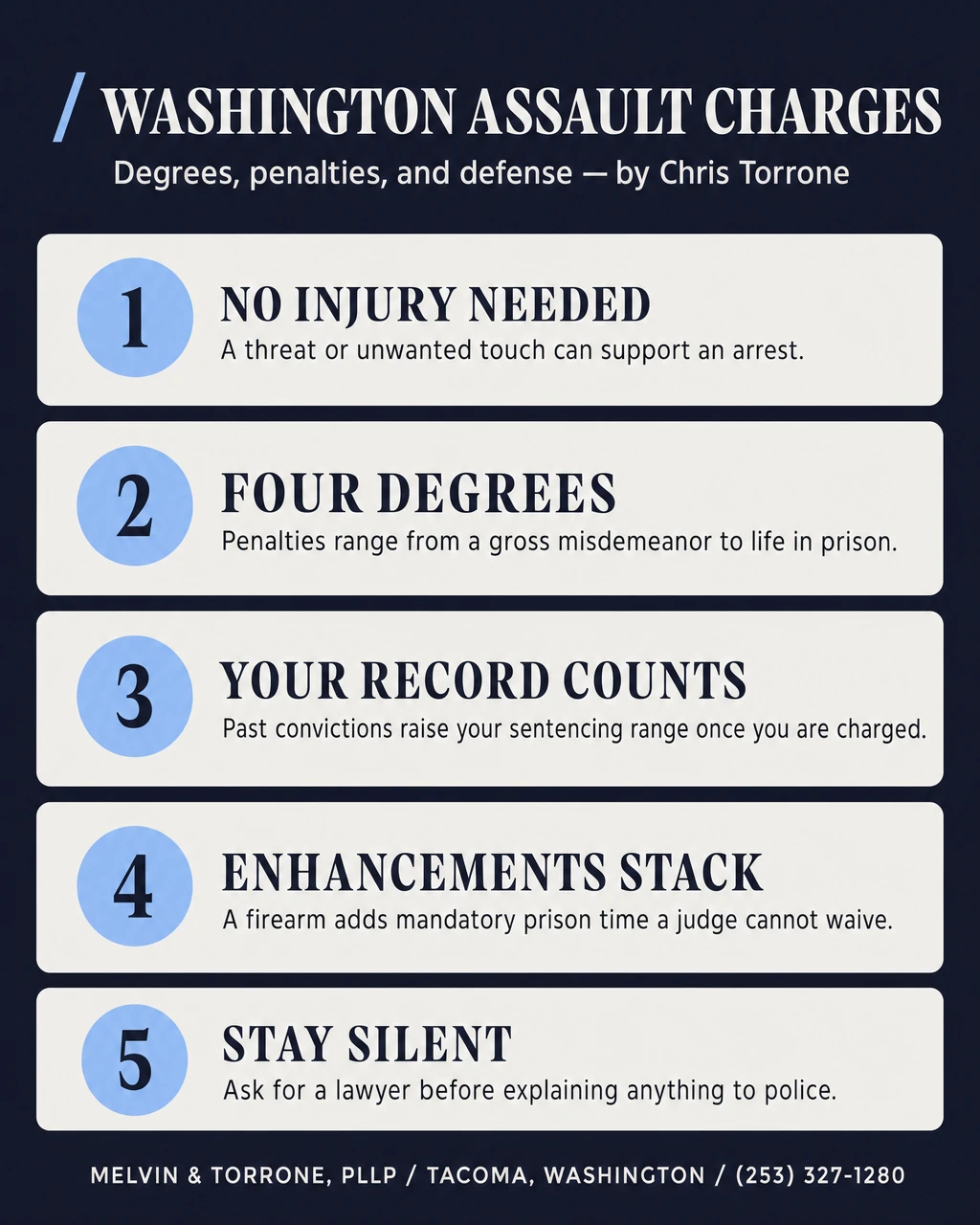
- Washington combines assault and battery into one crime, so you can be arrested even when no one was physically injured.
- The four degrees carry very different penalties, and the distance between a gross misdemeanor and a life sentence is shorter than most people assume.
- Your offender score, built from your criminal history, sets your sentencing range, which is why your record matters the moment you are charged.
- A firearm enhancement adds mandatory prison time that runs consecutively and that a judge cannot waive.
- Felony assault convictions strip your gun rights, surface on job and housing applications, and can trigger immigration consequences for non-citizens.
- Some assault convictions can later be vacated, but the waiting periods and eligibility rules trip people up, so the option is worth checking rather than assuming.
- The first days after an arrest carry the most weight, so stop talking and ask for a lawyer before you explain anything to anyone.
Table of Contents
- Torrone’s Takeaways
- What Counts as Assault Under Washington Law
- The Four Degrees of Assault and What Separates Them
- How Washington Calculates a Sentence
- Consequences That Outlast the Sentence
- Defense Strategies That Work in Pierce County
- What Happens After an Assault Arrest
- Can an Assault Conviction Be Vacated?
- Why Local Pierce County Defense Matters
- Conclusion
- Frequently Asked Questions
- Legal Disclaimer
- Sources
What Counts as Assault Under Washington Law
Washington folds assault and battery into one crime. Most states keep them separate, with assault meaning the threat and battery meaning the contact. Washington does not. Under Chapter 9A.36 RCW, the state treats both as assault, which means you can be charged whether you landed a blow or simply made someone reasonably fear one was coming.
Prosecutors can prove an assault three different ways, and they only need one:
- An intentional touching that a reasonable person would find harmful or offensive
- An act that puts another person in reasonable fear of imminent bodily harm
- The use of unlawful force against another person, even when no visible injury results
The fear route surprises people most. A raised fist, a sudden step forward, or a direct threat paired with the ability to carry it out can satisfy the standard with no contact at all.
The contact route surprises people just as much. A common situation I see is two neighbors in a heated argument where one grabs the other’s arm to make a point. Nobody goes to the hospital, and nobody has a mark. Under Washington’s definition, that unwanted contact can still support a fourth-degree assault arrest, because the law asks only whether a reasonable person would find the contact offensive, not whether it caused an injury.
I have seen charges filed over a shove, a poke to the chest, and a thrown cup of water. To put that in context, Washington law enforcement reported 18,064 aggravated assaults in 2024 in the state’s official crime report, and that figure does not even count the far more common simple-assault arrests.
The Four Degrees of Assault and What Separates Them
Washington recognizes four degrees of assault, and the gap between them is enormous. The classification controls the maximum penalty, whether the offense counts as a strike, and how much room a judge has at sentencing.
Assault in the first degree is the most serious. Under RCW 9A.36.011, it is a class A felony and covers conduct involving a firearm, a deadly weapon, or force likely to produce great bodily harm or death. A class A felony carries a statutory maximum of life imprisonment and a fine of up to $50,000. It is also a strike offense.
Assault in the second degree is a class B felony under RCW 9A.36.021. It reaches intentional assault causing substantial bodily harm, assault with a deadly weapon, and assault by strangulation or suffocation. A class B felony carries a maximum of ten years and a $20,000 fine.
The strangulation route matters in domestic violence cases, because officers are trained to ask whether hands went near the throat, and a yes can turn a misdemeanor scene into a felony arrest. Second-degree assault is also a strike offense, and it can rise to a class A felony when a court finds sexual motivation.
Assault in the third degree is a class C felony under RCW 9A.36.031, with a maximum of five years and a $10,000 fine. What sets it apart is often who the alleged victim is rather than how serious the injury was. Assaulting a law enforcement officer, a firefighter, a transit operator, or certain other protected workers performing their duties can land at this level. The same shove that would be fourth-degree assault against a stranger can be charged as third-degree assault when the other person is on duty in one of those roles.
Assault in the fourth degree is a gross misdemeanor under RCW 9A.36.041, carrying up to 364 days in jail and a $5,000 fine. It is the most commonly charged assault offense and the one I see most often in domestic disputes. The word misdemeanor makes it sound minor, and it is not. A conviction stays on your record, can cost you your firearm rights when a domestic relationship is involved, and shows up on background checks.
When fourth-degree assault is charged as domestic violence and you have certain prior convictions, the statute allows it to be elevated to a class C felony.
| Degree | Classification | Maximum confinement | Maximum fine | Strike offense | Common examples |
|---|---|---|---|---|---|
| Assault 1 | Class A felony | Life in prison | $50,000 | Yes | Firearm or deadly weapon causing great bodily harm |
| Assault 2 | Class B felony (class A if sexual motivation) | 10 years | $20,000 | Yes | Strangulation, substantial bodily harm, deadly weapon |
| Assault 3 | Class C felony | 5 years | $10,000 | No | Assaulting an on-duty officer, firefighter, or health care worker |
| Assault 4 | Gross misdemeanor (class C felony with DV plus certain priors) | 364 days | $5,000 | No | Offensive contact, minor altercation, domestic dispute |
How Washington Calculates a Sentence
Washington does not leave felony sentencing to a judge’s instinct. The state uses a structured grid under RCW 9.94A.510, where two numbers set your standard range: the seriousness level of the offense and your offender score. Your offender score is built from your criminal history under RCW 9.94A.525, so a record you thought was behind you can drive your range higher the moment you are charged. Judges in Pierce County Superior Court generally stay inside that range unless specific aggravating or mitigating factors justify an exceptional sentence, and those are rare.
Firearm enhancements sit on top of the standard range, and they are unforgiving. Under RCW 9.94A.533, a firearm enhancement adds a fixed block of time set by the class of the underlying felony: 60 months for a class A felony, 36 months for a class B felony, and 18 months for a class C felony. Those months are mandatory, served in total confinement, and run consecutively to everything else, and they double when a person already has a prior firearm or deadly weapon enhancement.
A common situation I see is someone charged with second-degree assault where a gun was present, who learns that the firearm enhancement stacks a mandatory three years on top of the base range, and that a judge who wants to show leniency on it legally cannot. For perspective, the average adult prison sentence in Washington was 52.6 months in fiscal year 2024, so a single enhancement can rival or exceed the base sentence.
A domestic violence designation changes the shape of a case beyond the charge itself. When DV is proven, Washington courts can impose no-contact orders, require a state-certified treatment program, and extend community custody. The designation also weighs on whether a court will consider alternatives to confinement. The day that tag appears, the defense strategy has to change with it.
Consequences That Outlast the Sentence
The penalties that follow you after the case closes are often the ones that hurt longest.
A felony assault conviction strips your right to possess a firearm under RCW 9.41.040. That applies to first, second, and third-degree assault. Even a fourth-degree assault conviction can cost you your gun rights when the offense involved a domestic relationship. Restoring those rights is a separate court process under RCW 9.41.041, and it is not automatic.
If you already have serious felony convictions, an assault charge can carry stakes beyond any single sentence. Washington was the first state to adopt a “three strikes” law, by voter initiative in 1993. First and second-degree assault both count as strike offenses, and under RCW 9.94A.570 a third conviction for a most serious offense means life in prison without the possibility of release. If you have priors, your current case deserves to be treated as if your future depends on it, because it might.
The collateral consequences reach further than most people expect. A felony assault conviction can touch:
- Employment, where background checks screen out applicants with felony records
- Housing, where landlords routinely deny applicants with violent-offense histories
- Professional licensing in fields like health care, education, and security
- Immigration status, where a conviction can trigger removal proceedings regardless of how long someone has lived here
Defense Strategies That Work in Pierce County
A real defense is built from the facts of your case, not a template. Still, a handful of approaches come up often in Washington assault cases.
Self-defense and defense of others. Washington recognizes no duty to retreat when you are somewhere you have a lawful right to be, and lawful use of force in defense of yourself or another is set out in RCW 9A.16.020. When self-defense succeeds, Washington law goes a step further: under RCW 9A.16.110, a defendant found not guilty by reason of self-defense can be reimbursed by the state for reasonable costs of the defense, including legal fees. The defense must point to some evidence that the force was lawful. Once self-defense is properly raised, the state carries the burden of proving beyond a reasonable doubt that it was not.
Challenging intent. Most assault charges require the state to prove you acted intentionally. If contact was genuinely accidental, that element is the opening, because the prosecution has to prove beyond a reasonable doubt that you meant to cause harm or fear. This comes up in crowded events, sports, and workplace accidents where bodies collide without anyone intending harm.
Inconsistent accounts and disputed allegations. A common situation I see is a person facing assault charges that grew out of a custody fight or a breakup, where the accuser’s account shifts between the first police contact and later statements. Documenting every inconsistency and testing credibility is ordinary, necessary defense work, and a careful review of police reports, witness statements, and any prior no-contact history can expose gaps early.
Mutual combat as a negotiating tool. When both people agreed to fight and neither was seriously hurt, the conduct may fit disorderly conduct, a simple misdemeanor, more accurately than assault. This is not a free pass, but it is a legitimate argument in plea discussions when the facts support it.
I will be straight about the limits here. None of these defenses guarantees a result, and which one fits depends entirely on your facts. Anyone who promises an outcome before reading your discovery is selling something.
What Happens After an Assault Arrest
The single biggest mistake I see is talking to police before talking to a lawyer. People are cooperative and polite, certain that explaining their side will clear everything up, and by the next business day their words are in the report and in the prosecutor’s hands. The right to remain silent exists for a reason, and using it is not an admission of guilt. Give your name, ask for a lawyer, and stop talking.
Your arraignment is your first formal court appearance, where the judge reads the charges and you enter an initial plea. Washington’s Board for Judicial Administration sets a goal that 90% of criminal cases be resolved within four months of filing. Real-world timelines in Pierce County often run longer than that target, but the early weeks still carry weight you do not want to spend without representation.
Bail depends on the severity of the charge, your history, your ties to the community, and whether a no-contact order is in play. Having a lawyer at your first appearance can shape that decision, because someone has to give the court a fuller picture of who you are than the charge on the paper.
Can an Assault Conviction Be Vacated?
Washington does not use the word expungement. The closest relief is vacation, which sets aside the guilty finding, dismisses the charge, and lets you state you were not convicted of that offense.
For a fourth-degree assault, vacation runs through RCW 9.96.060. The standard wait is three years after you complete all sentence conditions, and it extends to five years when the offense was domestic violence. The clock does not start until every condition, including financial obligations and supervision, is satisfied, which trips up people who assume they are already eligible.
Felony assault vacation is governed by a different statute, RCW 9.94A.640, and the rules are stricter. Class A felonies and violent offenses generally cannot be vacated, which rules out first-degree assault. The statute does carve out second and third-degree assault when the conviction did not include a firearm, deadly weapon, or sexual-motivation enhancement, with a wait of ten years for a class B felony and five years for a class C felony.
| Conviction | Vacation eligibility | Minimum wait | Governing statute |
|---|---|---|---|
| Assault 4, no DV | Eligible | 3 years after all sentence conditions complete | RCW 9.96.060 |
| Assault 4 with DV | Eligible, with conditions | 5 years after all conditions complete | RCW 9.96.060 |
| Assault 3, not against law enforcement, no enhancement | Eligible | 5 years (class C felony) | RCW 9.94A.640 |
| Assault 2, no firearm, deadly weapon, or sexual-motivation enhancement | Eligible | 10 years (class B felony) | RCW 9.94A.640 |
| Assault 1 (class A, violent offense) | Generally not eligible | Not applicable | RCW 9.94A.640 |
Eligibility is fact-specific, and the table simplifies rules that have additional conditions, so confirm your own situation with an attorney before relying on it. Vacating a conviction does not automatically restore firearm rights, which is a separate court process. Because the eligibility analysis overlaps, both questions are often best handled together.
Why Local Pierce County Defense Matters
Pierce County prosecutors handle a high volume of assault cases and know the arguments that tend to fall apart in this courthouse. Every judge in Pierce County Superior Court has tendencies that experienced local attorneys recognize, and those patterns shape everything from how a defense is framed to which plea terms are realistic. Generic legal advice tells you what the statute says. A local defense plan tells you how that statute plays out in front of your judge, against your prosecutor, on your specific facts.
Conclusion
An assault charge in Washington turns on the details: the degree, your record, whether an enhancement applies, and the choices you make in the first days. The degree on your paperwork is the starting point, not the verdict. Understanding exactly what the state is alleging, staying quiet until you have advice, and building the defense early are what protect your record, your rights, and your family.
Frequently Asked Questions
1. What is the difference between fourth-degree assault and a higher-degree charge in Washington?
Fourth-degree assault is a gross misdemeanor covering offensive contact or minor altercations, while the higher degrees involve weapons, serious injury, or protected victims such as on-duty law enforcement. The specific facts and your criminal history determine where prosecutors file the charge.
2. Can a Washington assault charge involve family or household members who are not spouses?
Yes. Washington’s domestic violence laws cover a broad set of relationships, including family and household members and dating relationships, not only married couples. An assault within those relationships triggers a domestic violence designation that affects your charge, your sentencing exposure, and your firearm rights.
3. Do out-of-state convictions count toward my offender score in Washington?
Generally yes. Out-of-state offenses are classified by their closest Washington equivalent and can be counted in your offender score under RCW 9.94A.525, which can push your standard sentencing range higher even if your Washington record is clean.
4. Can witness tampering charges be added to an assault case?
Yes. Under RCW 9A.72.120, tampering with a witness is a separate class C felony, and trying to influence or discourage a witness, even through a third party, can add charges on top of the original case.
5. Can I lose my job over an assault arrest before any conviction?
It depends. Washington’s Fair Chance Act limits how employers use criminal history in hiring, but certain public agencies and positions involving vulnerable people are exempt, and an arrest can have employment consequences in some regulated fields even before a case resolves.
6. How does a domestic violence designation change an assault case?
A DV designation can bring mandatory no-contact orders, required treatment, and extended community custody, and it influences whether a court will consider alternatives to confinement. It can also affect firearm rights immediately, which is why the designation reshapes the whole defense approach.
7. What happens if my assault charge involves an allegation of sexual motivation?
A sexual-motivation finding adds a separate layer of consequences, including potential sex-offender registration. Washington courts treat sexual motivation as an aggravating factor that can raise the sentencing exposure and add supervision beyond the standard release date.
8. Can mental health or substance use treatment affect sentencing for an assault conviction?
It can. Judges in Washington have discretion to order mental health or substance use treatment as a condition of community custody or probation, and completing court-ordered treatment through an approved provider can be viewed favorably at sentencing and in later hearings.
Legal Disclaimer
This article is for general informational purposes only and is not legal advice. Reading it or contacting Melvin & Torrone, PLLP does not create an attorney-client relationship. Each case is unique, and past results do not guarantee future outcomes. For advice about your specific situation, speak with a licensed Washington attorney.
Sources
- RCW 9A.36: Assault, Reckless Endangerment, etc.
- RCW 9A.36.011: Assault in the first degree
- RCW 9A.36.021: Assault in the second degree
- RCW 9A.36.031: Assault in the third degree
- RCW 9A.36.041: Assault in the fourth degree
- RCW 9A.20.021: Maximum sentences by class
- RCW 9.94A.510: Sentencing grid
- RCW 9.94A.525: Offender score
- RCW 9.94A.533: Sentence enhancements
- RCW 9.94A.570: Persistent offenders
- RCW 9.41.040: Unlawful possession of firearms
- RCW 9.41.041: Restoration of firearm rights
- RCW 9A.16.020: Lawful use of force
- RCW 9A.16.110: Reimbursement for defending against violent crime
- RCW 9A.72.120: Tampering with a witness
- RCW 9.96.060: Vacating misdemeanor records
- RCW 9.94A.640: Vacating felony records
- Washington Caseload Forecast Council, FY2024 Adult Statistical Summary
- Washington Association of Sheriffs and Police Chiefs, Crime in Washington 2024
- Washington Courts, Criminal Case Management Statistics

Chris Torrone
Founding Partner, Melvin & Torrone PLLP
Chris Torrone is a dedicated advocate for clients facing family crises and criminal charges. With 20 years of experience practicing in Pierce County courts, Chris has built a reputation for meticulous case preparation and creative problem-solving in high-stakes litigation.