
Domestic Violence Defense for the Accused in Washington

Accused of domestic violence? You have more options than you think. A domestic violence charges defense for the accused is not a lost cause. False accusations happen every day, the evidence is often thinner than prosecutors let on, and reasonable doubt is a powerful thing. After 20 years of fighting these cases in Pierce County courtrooms, I have seen good people get their lives back because they had the right defense team in their corner early. Let me walk you through exactly what your options are and how to protect your future starting right now.
Torrone’s Takeaways
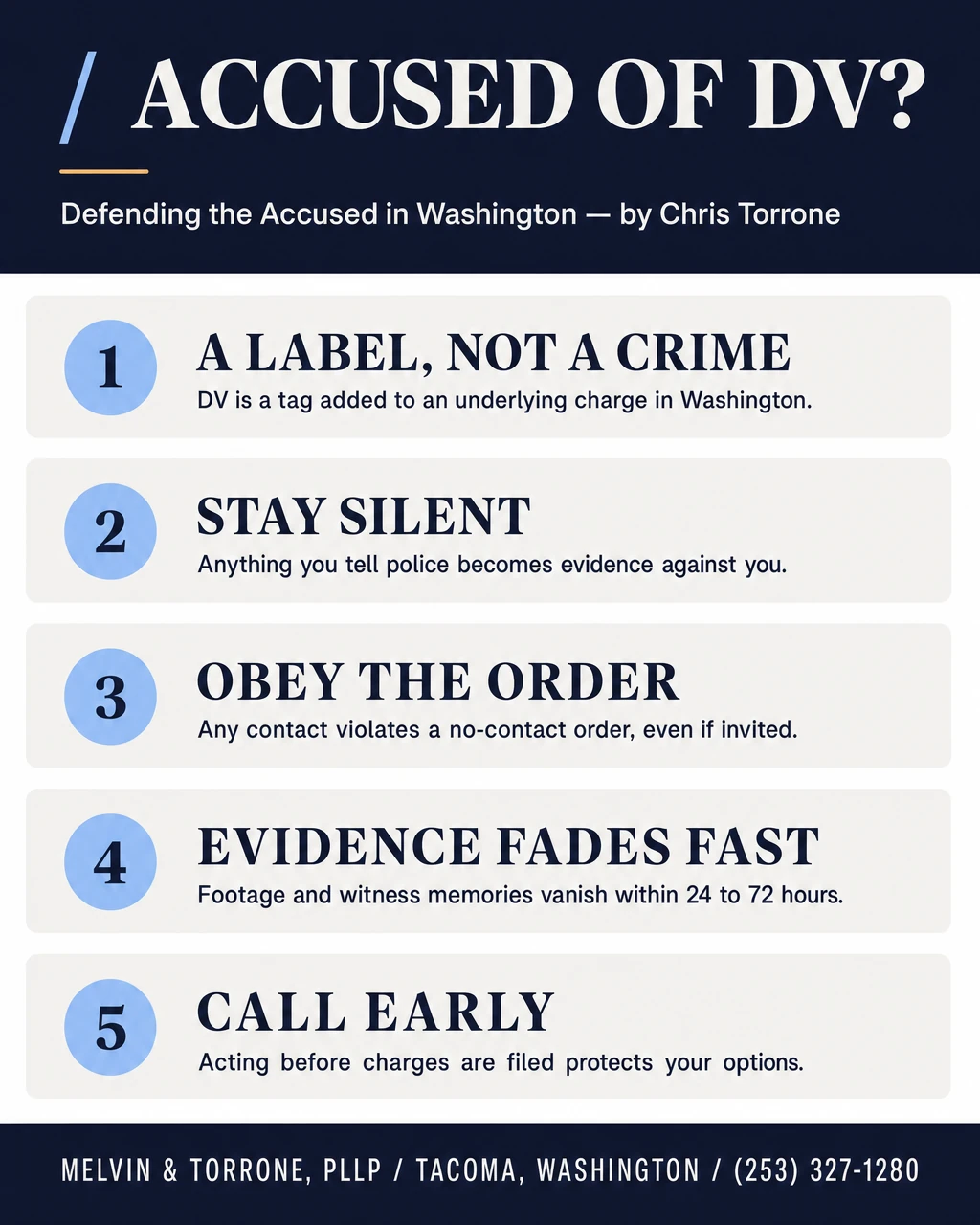
- Domestic violence is a label in Washington, not a standalone crime.
- Washington’s mandatory arrest law gives officers almost no discretion. If probable cause exists, you are going to jail regardless of the full story.
- A no-contact order can remove you from your own home before a single fact is proven in court.
- False accusations are far more common than people think, especially during divorce and custody disputes. Evidence gathered early is your best weapon.
- Talking to police without an attorney present is one of the most damaging things you can do. Stay silent and call a lawyer immediately.
- Even a misdemeanor DV conviction can cost you your gun rights, your job, and your relationship with your children.
- The earlier you get an experienced defense team involved, the more options you have. Waiting costs you leverage you cannot get back.
Table of Contents
- Torrone’s Takeaways
- What a Domestic Violence Charge Actually Means in Washington State
- What Happens to You Immediately After a Domestic Violence Arrest in Pierce County
- The Long-Term Consequences Most Accused People Don’t See Coming
- Most Effective Defense Strategies for Domestic Violence Charges Defense for the Accused
- How False Accusations Happen and How to Fight Back Against Them
- Critical Mistakes Accused People Make That Hurt Their Own Case
- How the Domestic Violence Defense Process Works in Pierce County Courts
- Can a Domestic Violence Conviction Be Removed From Your Record in Washington
- How Melvin & Torrone, PLLP Fights for the Accused in Pierce County
- Frequently Asked Questions
- Conclusion
What a Domestic Violence Charge Actually Means in Washington State
”Domestic Violence” Is a Label, Not a Standalone Crime
Something most people do not realize until they are already sitting in a courtroom is that domestic violence is not an actual crime in Washington State. It is a label. Under RCW 10.99.020, prosecutors attach it to underlying charges like assault, harassment, or property damage when the accused and the alleged victim share a qualifying relationship. That label changes everything about how your case is handled.
Which Relationships Qualify Under Washington’s DV Laws
Washington casts a wide net when defining domestic violence relationships. Current or former spouses, people who share a child, roommates, dating partners, and even former dating partners all qualify under RCW 26.50.010. I have seen people genuinely surprised to find that a DV tag applied to their case based on a relationship that ended years ago. If you shared a household or had any romantic connection with the other person, you are very likely covered under this law.
How a DV Tag Changes the Consequences of an Underlying Charge
A DV tag is not just a label on paper. It is a multiplier. In Washington, that designation can add up to 60 months of probation, trigger an immediate firearms surrender under federal law, and result in a no-contact order that removes you from your own home before you have had a single day in court.
A common pattern we see is someone facing a harassment charge tied to a former partner they once lived with, assuming harassment is a minor matter. The DV tag can cost a concealed carry permit while the case is pending, before any conviction has even occurred. In 2024, the Washington Association of Sheriffs and Police Chiefs reported that domestic violence offenses made up nearly half of all crimes against persons statewide. Pierce County prosecutors take these cases very seriously, and so should you.
Table: Washington State Domestic Violence Charges at a Glance
| Underlying Charge | DV Tag Applied When | Classification | Maximum Jail Time | Maximum Fine |
|---|---|---|---|---|
| Assault (4th degree) | Physical contact with household member or partner | Gross Misdemeanor | 364 days | $5,000 |
| Harassment | Threats made to qualifying household member or partner | Gross Misdemeanor | 364 days | $5,000 |
| Assault (2nd degree) | Serious bodily injury or deadly weapon involved | Class B Felony | 10 years | $20,000 |
| Assault (1st degree) | Great bodily harm with deadly weapon | Class A Felony | Life | $50,000 |
| Stalking | Pattern of conduct causing fear to intimate partner | Class B Felony | 10 years | $20,000 |
| Property Damage/Malicious Mischief | Destruction of property of household member or partner | Misdemeanor to Felony | Varies | Varies |
| Violation of No-Contact Order | Any contact with protected person while order is active | Gross Misdemeanor to Felony | Up to 5 years | $10,000 |
What Happens to You Immediately After a Domestic Violence Arrest in Pierce County
Washington’s Mandatory Arrest Law
Washington State operates under a mandatory arrest law for domestic violence situations. Under RCW 10.99.040, if a responding officer finds probable cause to believe a domestic violence crime occurred, they must make an arrest. It does not matter if there are no visible injuries, no witnesses, or if both parties are calm by the time law enforcement arrives. The officer’s hands are largely tied.
First Court Appearance and What Gets Decided There
Your first court appearance, called the arraignment, happens fast, usually within 24 to 72 hours of your arrest. This is not the time to tell your side of the story. The judge reads the charges, you enter a plea, and then several consequential decisions get made about your release conditions. I always tell clients to plead not guilty at arraignment unless they have already spoken with an experienced domestic assault lawyer who advises otherwise.
How No-Contact Orders Are Issued and What They Actually Restrict
No-contact orders in Washington are issued routinely at arraignment, and here is what catches most people off guard: the judge can issue one even if the alleged victim does not want it. Once in place, a no-contact order can prohibit you from returning to your own home, contacting your children, or communicating with your partner in any way. Violating it, even if your partner reaches out to you first, is a separate criminal offense.
A typical no-contact order can restrict the following in Washington State:
- Returning to a shared residence
- Any direct contact with the protected person, including phone calls and text messages
- Indirect contact through third parties, including friends and family members
- Being within a specified distance of the protected person’s home, workplace, or school
- Possessing or purchasing firearms during the pendency of the case
Your Firearm Rights After a DV Arrest in Washington
This one surprises a lot of people, especially those who work in law enforcement, security, or the military. A domestic violence arrest in Washington triggers an immediate requirement to surrender any firearms you own while the case is pending. If you are ultimately convicted, even of a misdemeanor domestic violence crime, the federal Lautenberg Amendment imposes a lifetime firearms ban under 18 U.S.C. § 922(g). As of 2021, misdemeanor domestic violence convictions were the fourth most common reason for firearm purchase denial by the FBI nationwide, according to the Bureau of Justice Statistics.
A common scenario involves someone with no prior criminal record arrested after a single argument escalates and a neighbor calls 911, assuming the situation will resolve itself quickly. What many people do not anticipate is surrendering firearms the morning after an arrest and facing the real possibility of a permanent federal gun ban. Getting ahead of these consequences early, before a conviction ever happens, is exactly why calling a criminal defense attorney the same night of your arrest matters so much.
The Long-Term Consequences Most Accused People Don’t See Coming
How a DV Conviction Follows You Into Employment and Housing
Most people focus on avoiding jail time and stop there. What they miss is the quiet damage a domestic violence conviction does long after the case closes. Background checks flag it immediately, and many employers in healthcare, education, financial services, and government positions are legally restricted from hiring someone with a domestic assault conviction on their record. Housing applications get denied for the same reason.
The Impact on Child Custody and Family Court Proceedings
A domestic violence conviction does not stay in the criminal courtroom. It follows you directly into family court, where a judge deciding child custody will treat it as highly relevant evidence. Research published through the California Courts system found that domestic violence is an issue in between 25% and 50% of all contested custody cases nationally. I have watched a criminal conviction tip the scales in a custody battle that had nothing to do with parenting ability, and it is painful every single time.
A common pattern involves a parent going through a divorce who faces a misdemeanor domestic assault charge from a single incident with a soon-to-be ex-spouse. Often it is not their career that keeps them up at night, but the fear of losing custody of their children. A charge like this can become the centerpiece of the other party’s family relations argument in court and put parenting rights at serious risk.
What Felony vs. Misdemeanor DV Charges Mean for Your Sentencing
In Washington, domestic violence is not a standalone crime, so the felony or misdemeanor classification comes from the underlying charge. A gross misdemeanor conviction can mean up to 364 days in jail and fines up to $5,000, while felony charges carry significantly longer sentences under Washington State Sentencing Guidelines. The distinction also determines how long probation lasts, whether a criminal protective order applies, and how difficult it will be to vacate the conviction from your record later.
Most Effective Defense Strategies for Domestic Violence Charges Defense for the Accused
1. Self-Defense and Defense of Others
Self-defense is one of the most legitimate and frequently used strategies in domestic violence cases, and Washington law specifically protects it. Under RCW 9A.16.020, you have the legal right to use reasonable force to protect yourself or another person from imminent harm. The person who calls 911 first is not automatically the victim. I have defended many clients who were the ones actually being attacked, and the physical evidence told a completely different story than the police report did.
2. Proving False Accusations With Evidence and Witness Testimony
False allegations in domestic violence cases are more common than most people realize. A national survey by the Center for Prosecutor Integrity found that approximately 20.4 million Americans report being falsely accused of domestic violence or a related offense, with 27% of those false charges arising during child custody disputes. Text messages, social media posts, surveillance footage, prior police reports, and witness accounts from neighbors or family members can all expose inconsistencies in an accuser’s story. I look for those cracks immediately.
3. Lack of Evidence and How Prosecutors Must Prove Guilt Beyond Reasonable Doubt
Reasonable doubt is one of the most powerful tools available in a criminal case, and domestic violence prosecutions often rest on surprisingly thin evidence. A peer-reviewed study in SAGE Open found that single-charge misdemeanor domestic violence police reports resulted in a criminal conviction only 29% of the time. When physical evidence is absent and the case comes down to one person’s word against another’s, a skilled criminal defense attorney can expose the prosecution’s insufficient evidence and push hard for dismissal. The burden of proof is always on them, never on you.
Prosecutors typically need these to secure a conviction in a domestic violence criminal case:
- Credible physical evidence such as injuries, damaged property, or medical records documenting bodily injury
- Reliable witness testimony or eyewitness accounts that corroborate the alleged victim’s version of events
- A 911 emergency call recording or police reports that are consistent with the allegations
- Evidence establishing the qualifying domestic relationship between the accused and the alleged victim
- Proof beyond reasonable doubt that the accused was the initial aggressor, not acting in self-defense
4. Challenging Unlawful Arrests and Constitutional Violations
Law enforcement officers are required to follow strict procedures during a domestic violence arrest, and when they do not, that becomes part of your defense. If officers failed to give a proper Miranda warning, conducted an unlawful search, or lacked genuine probable cause for the arrest, any evidence gathered as a result may be suppressible in court. A good criminal defense lawyer does not just look at what happened between the two parties. I look at everything law enforcement did from the moment they arrived on scene.
5. Mutual Combat and Shared Responsibility Arguments
Some domestic violence situations involve two people who both engaged in physical confrontation, which raises genuine questions about who bears sole legal responsibility. Washington courts recognize mutual combat scenarios, and when both parties contributed to the altercation, it can significantly weaken the prosecution’s case against you specifically.
When both people are involved in a physical argument yet only one is charged, witness statements and the responding officer’s own notes can establish shared responsibility. Shared fault does not automatically mean shared conviction.
How False Accusations Happen and How to Fight Back Against Them
Scenarios Where False DV Accusations Arise in Washington
False accusations do not always come from nowhere. In my experience, they tend to cluster around specific high-stress situations where one party feels they have something to gain. The most common triggers I see in Pierce County cases are contentious divorce proceedings, child custody disputes, financial disagreements between former partners, and heated arguments that one party later exaggerates to law enforcement. Knowing which scenario you are in helps us build the right counter-strategy from day one.
Types of Evidence That Expose Inconsistencies in an Accuser’s Story
The good news is that false allegations tend to fall apart under scrutiny. Text messages, social media posts, prior police reports, surveillance footage, medical records, eyewitness accounts, and even the accuser’s own statements to a victim’s advocate can contradict each other in ways that are very hard to explain away.
A frequent pattern involves a domestic assault complaint filed shortly before a divorce hearing, where the accuser’s own text messages from that same period tell a completely different story. Gathering that evidence early, before the state’s attorney has even reviewed the file, can be decisive.
What Your Attorney Can Do Before Charges Are Even Filed
Most people do not realize that the window between an accusation and formal charges being filed is genuinely valuable time. I can contact the prosecutor’s office directly, present contradicting evidence, flag credibility issues with the accuser’s account, and in some cases make the argument that filing charges is not supported by the available evidence. Getting a criminal defense attorney involved before charges are filed is not just smart. In Washington, it can sometimes mean those charges never appear on your criminal record at all.
Critical Mistakes Accused People Make That Hurt Their Own Case
1. Violating a No-Contact Order Even When the Other Party Invites
This is the mistake I see most often, and it is entirely avoidable. In Washington, it does not matter if your partner calls you, texts you first, or shows up at your door asking to talk. If a no-contact order is in place, any response from you is a criminal offense. Violating it can land you back in jail immediately and hands the prosecution a gift they will absolutely use against you at trial.
Never do these once a no-contact order is issued, regardless of what the other party says or does:
- Respond to any calls, texts, or messages from the protected person
- Allow the protected person into your home or vehicle
- Send messages through mutual friends or family members on your behalf
- Post anything directed at the protected person on social media
- Attend any location where you know the protected person will be present
2. Talking to Police Without an Attorney Present
I cannot stress this enough: anything you say to law enforcement after a domestic violence arrest can and will be used against you. Officers are trained interviewers, and even a calm, reasonable explanation can be twisted into something that looks like an admission in a police report. Your Miranda warning exists for a reason. Invoke your right to remain silent, ask for an attorney, and then stop talking until that attorney is present with you.
3. Waiting Too Long to Hire a Defense Lawyer
Time genuinely matters in domestic violence cases. Evidence disappears, witnesses forget details, and surveillance footage gets overwritten, sometimes within 24 to 72 hours of an incident. We have seen what happens when someone waits weeks after an arrest, convinced the situation will sort itself out: a key neighbor witness moves away, or an apartment complex overwrites the hallway camera footage that would have supported their account. Early action protects your options. Waiting closes them.
Table: Your Rights vs. Common Misconceptions After a DV Arrest in Washington
| Common Misconception | Reality |
|---|---|
| ”The victim can drop the charges whenever they want.” | Only the prosecutor controls whether charges proceed. The alleged victim cannot unilaterally dismiss a criminal case. |
| ”If there are no injuries, there is no case.” | Washington law does not require visible physical injury for a domestic assault charge to stick. |
| ”I can explain my side to police and clear this up.” | Anything you say without an attorney present becomes evidence. A Miranda warning exists for a reason. |
| ”A misdemeanor DV conviction is not a big deal.” | Even a misdemeanor triggers a lifetime federal firearms ban, probation, and lasting damage to background checks. |
| ”The no-contact order ends when the case ends.” | No-contact orders can remain in place long after a case is resolved, sometimes for years. |
| ”If my partner invites contact, I am not violating the order.” | The protected person cannot waive a court-issued no-contact order. Any contact from you is still a criminal offense. |
| ”I can wait and see how things develop before hiring a lawyer.” | Surveillance footage, witness memories, and critical evidence can disappear within 24 to 72 hours of an incident. |
How the Domestic Violence Defense Process Works in Pierce County Courts
From Arraignment to Plea Negotiation in a Washington DV Case
Your arraignment is just the starting line, not the finish. After you enter a not guilty plea, the case moves into a pretrial phase where your defense attorney reviews discovery, challenges evidence, and opens negotiations with the prosecutor. Plea bargaining resolves the overwhelming majority of criminal cases in Washington, and a skilled domestic assault attorney can use weaknesses in the prosecution’s case to negotiate reduced charges or lighter sentencing outcomes well before trial ever becomes necessary.
When a Case Goes to Trial and What to Expect
Not every domestic violence case settles through plea bargaining, and sometimes going to trial is the right call. In a bench trial, a judge alone reviews the evidence and decides guilt or innocence. In a jury trial, your attorney works through jury selection to ensure a fair panel, then presents witness testimony, challenges physical evidence, and cross-examines the prosecution’s witnesses to create reasonable doubt. It is intense, but a well-prepared defense team knows exactly how to build a case that holds up in a Pierce County courtroom.
How Domestic Violence Charges Defense for the Accused Can End in Dismissal or Reduction
Dismissal and charge reduction are real possibilities, not just optimistic talk. For service members, felony domestic assault charges can threaten a security clearance and an entire career.
A strong defense looks for procedural errors in the arrest, challenges the physical evidence, and surfaces inconsistencies between the alleged victim’s account and the responding officer’s own police reports. Prosecutors dismiss or reduce charges regularly when a defense attorney presents a well-documented case that makes conviction uncertain.
Can a Domestic Violence Conviction Be Removed From Your Record in Washington
Who Qualifies to Have a DV Conviction Vacated
Yes, vacation is possible in Washington, but the bar is higher for domestic violence than for most other offenses. Under RCW 9.96.060, you must have completed every term of your sentence, including all fines and fees. You also cannot have any pending criminal charges, any new convictions, or any active protection orders against you.
To qualify for vacation of a domestic violence conviction in Washington, you must meet all of the following conditions:
- Completed all sentence terms including financial obligations
- No pending criminal charges in any state
- No new criminal convictions since the DV conviction
- Not currently restrained by a no-contact order, order of protection, or anti-harassment order
- No violation of a restraining order within the past five years
The Waiting Periods for Misdemeanor vs. Felony Vacations
Timing matters significantly when pursuing vacation of a domestic violence conviction. For misdemeanor and gross misdemeanor DV convictions in Washington, courts generally require that meaningful time has passed since sentence completion before a vacation petition will be considered. Felony domestic violence convictions carry longer waiting requirements and face additional scrutiny under Washington State sentencing guidelines, making early legal guidance on record sealing strategy genuinely worthwhile.
DV Convictions Are Harder to Vacate Than Other Offenses
Domestic violence convictions receive special treatment in Washington’s legal system, and not in your favor. Even after vacation under RCW 9.96.060, a 2023 Washington State Office of Financial Management feasibility study confirmed that third-party consumer reporting agencies may still surface vacated DV records through bulk court data purchases.
Professionals in licensed fields like healthcare can discover this the hard way when a background check flags a vacated misdemeanor conviction during a credentialing process, putting a promotion or position at risk. Getting ahead of this with proper legal guidance on record sealing makes a significant difference.
How Melvin & Torrone, PLLP Fights for the Accused in Pierce County
Our Approach to Domestic-Violence Defense
At Melvin & Torrone, PLLP, we do not guess at defense strategies. We build them deliberately, using 20-plus years of Pierce County courtroom experience and deep knowledge of local prosecutors. Jordan Foster leads our domestic-violence defense work, built on years of real cases and real fights in Tacoma courtrooms.
What Sets Jordan Foster and Chris Torrone Apart in Tacoma Courtrooms
Jordan Foster and I have spent decades on opposite sides of this system, and we know exactly how prosecutors think. Jordan is a Rising Star Washington Super Lawyers honoree, a Peer Review Rated attorney, and an active member of the Washington Association of Criminal Defense Lawyers. Together, we bring a combined depth of criminal defense and family law knowledge that few firms in Pierce County can match.
Every client at Melvin & Torrone, PLLP receives these from day one:
- A thorough case review and honest assessment of your options
- Direct access to an experienced domestic assault attorney, not a paralegal
- A defense strategy built specifically around the facts of your case
- Clear communication at every stage so you always know where things stand
- Fierce, aggressive representation in Pierce County courts and beyond
Your First Step Is a Free Consultation With a Lawyer Who Fights for You
You do not have to figure this out alone, and you should not try. A free 30-minute consultation with Melvin & Torrone, PLLP gives you immediate clarity on your situation, your rights, and your realistic options. Call us at (253) 327-1280, visit our office at 950 Pacific Ave, Suite 720, Tacoma, or fill this contact form online to schedule your consultation today.
Frequently Asked Questions
1. Can emotional abuse or financial control lead to a domestic violence charge in Washington State?
Yes, absolutely. Washington’s domestic violence laws extend beyond physical assault and can include patterns of psychological manipulation, financial control, and emotional abuse when they occur within a qualifying domestic relationship.
2. What is a 50B Order and does it apply in Washington State?
A 50B Order is a term used in North Carolina for a domestic violence protective order. Washington State uses its own domestic violence protection order system under RCW 7.105, which functions similarly but operates under different procedural rules.
3. Can a domestic violence charge affect my gun rights even before a conviction?
Yes, and this catches many people off guard. A DV arrest in Washington triggers an immediate firearm surrender requirement, and a criminal domestic abuse conviction results in a lifetime federal ban on gun rights under the Lautenberg Amendment.
4. What happens if the alleged victim recants or refuses to cooperate with the state’s attorney?
The state’s attorney can still proceed with prosecution even without the alleged victim’s cooperation. Prosecutors may rely on police records, 911 recordings, medical records, and witness accounts to build their case independently.
5. Can mistaken identity be used as a defense in a Washington domestic violence case?
Yes, mistaken identity is a recognized defense in criminal cases, including domestic assault. If evidence places you elsewhere or contradicts the accuser’s identification, your attorney can present that through witness testimony and supporting documentation.
6. Will a domestic violence charge affect my standing with the Department of Children and Families?
It can, significantly. A domestic violence arrest or conviction can trigger involvement from child welfare agencies and directly impact custody evaluations, parenting plans, and family relations proceedings in Pierce County family court.
7. How does aggravated domestic violence differ from a standard domestic assault charge in Washington?
Aggravated domestic violence typically involves the use of a deadly weapon, serious bodily injury, or prior convictions that elevate the underlying charge to felony level. The sentencing consequences and reputation harm associated with aggravated charges are substantially more severe.
8. How do domestic violence laws in Washington compare to other states?
Washington does not have a standalone domestic violence statute the way Ohio Revised Code 2919.25 or Virginia Code Section 18.2-57.2 do. Instead, Washington applies a DV designation to existing criminal charges, which affects sentencing, record sealing eligibility, and collateral consequences differently than those state frameworks.
9. Should I work with a bail bond agent immediately after a domestic violence arrest in Pierce County?
Connecting with bail bond agents quickly can help you secure release, but your more urgent call should be to a criminal defense attorney. An attorney can sometimes influence release conditions and no-contact order terms at your very first court appearance.
10. How does sexual battery factor into a domestic violence case in Washington State?
Sexual battery within a domestic relationship can be charged as a separate felony offense alongside a domestic violence designation in Washington. Unlike states operating under Florida Statutes Section 741.28, Washington handles these as distinct but related charges, and conviction carries serious long-term consequences for your criminal record and personal reputation.
Conclusion
A domestic violence charge in Washington State moves fast and hits hard. The decisions you make in the first 24 to 48 hours shape everything that follows. At Melvin & Torrone, PLLP, we have spent decades standing beside people in exactly your situation, fighting aggressively for their freedom, their families, and their future. You deserve a defense built around your specific case, not a generic playbook. Let us build that together.
Book Your Free Consultation Today.
Each case is unique. Past results do not guarantee future outcomes. This article provides legal information, not legal advice. Reading this article does not create an attorney-client relationship with Melvin & Torrone, PLLP.

Chris Torrone
Founding Partner, Melvin & Torrone PLLP
Chris Torrone is a dedicated advocate for clients facing family crises and criminal charges. With 20 years of experience practicing in Pierce County courts, Chris has built a reputation for meticulous case preparation and creative problem-solving in high-stakes litigation.