
How To Divorce A Disabled Spouse?

Yes, you can divorce a disabled spouse in Washington State, and the law protects both parties through specific spousal support and property division rules. I’ve helped countless families through these emotionally complex situations over two decades, and I know the guilt and confusion you’re feeling right now.
Divorcing disabled spouses involves special considerations for disability benefits like Social Security Disability Insurance and Supplemental Security Income that most attorneys never explain clearly. This affects child custody arrangements, medical costs, and your financial future in ways standard divorce cases don’t address.
Let me walk you through exactly how Washington law handles these sensitive situations with the compassion and clarity you deserve.
Torrone’s Takeaways
-
Washington law specifically protects disabled spouses through RCW 26.09.090, often resulting in longer spousal support periods than standard divorces
-
Divorce can actually improve your spouse’s disability benefits by reducing household income for SSI and Apple Health eligibility
-
Pierce County courts provide ADA accommodations and appoint guardians ad litem when cognitive disability prevents understanding legal proceedings
-
COBRA coverage extends to 36 months for disabled former spouses, giving critical time to transition to Apple Health programs
-
Special needs trusts protect your spouse’s Medicaid eligibility while ensuring fair property division under Washington community property laws
-
Caregiver burnout is real and valid; prioritizing your own health doesn’t make you selfish or cruel
-
Timing matters tremendously for benefit preservation, so consult legal counsel before filing to avoid costly mistakes with government programs
Table of Contents
- What Washington Law Says About Divorcing a Disabled Spouse
- How Disability Changes Financial Decisions in Washington Divorce
- What Happens to Government Benefits After You Divorce a Disabled Spouse in Washington
- How Pierce County Courts Handle Divorce with a Disabled Spouse
- Creating Parenting Plans When Disability Affects Custody
- Insurance and Healthcare Coverage After Divorcing a Disabled Spouse
- When Divorcing Your Disabled Spouse Is the Right Decision
- Estate Planning and Long-Term Financial Protection After Divorce
- Melvin & Torrone PLLP Understands Complex Disability Divorces
- Frequently Asked Questions
- Conclusion
What Washington Law Says About Divorcing a Disabled Spouse
RCW 26.09.090 and How Disability Impacts Spousal Maintenance
Washington’s maintenance statute specifically considers your spouse’s physical and emotional condition when calculating spousal support. Courts look at whether disability existed before marriage or developed during your union, because this affects property division dramatically. I’ve seen judges award longer maintenance periods when a spouse’s disability limits their earning capacity, even if the marriage was relatively short.
Legal Capacity Requirements Under Washington State Law
Your spouse must understand they’re getting divorced and grasp the basic legal consequences. If cognitive disability prevents this understanding, Pierce County courts appoint a guardian ad litem to protect their interests during proceedings. When one spouse has a condition like early-onset dementia, a GAL helps ensure that spouse receives a fair property settlement while the other spouse can still move forward with a necessary legal separation after years of caregiver burnout. The appointment protects the vulnerable party without forcing the healthier spouse to stay married indefinitely.
When You Can Choose Legal Separation Over Divorce in Washington
Legal separation under RCW 26.09.015 keeps your spouse on your health insurance while dividing finances and living arrangements separately. This option preserves disability benefits that marriage maintains, like dependent benefits through Social Security Disability Insurance. Some clients choose this path when divorce would devastate their spouse’s medical costs coverage, giving both parties breathing room without the financial impact of full divorce.
How Disability Changes Financial Decisions in Washington Divorce
Community Property Division When One Spouse Has a Disability
Washington divides marital assets justly and equitably under RCW 26.09.080, often roughly equal but not an automatic 50/50 split, and disability weighs heavily in that calculation. Courts consider which spouse needs the family home for accessibility modifications, who requires special medical equipment, and how care requirements affect each person’s housing needs. I’ve seen judges award the accessible ground-floor home to the disabled spouse even when it meant the other party received different assets to balance the property division.
Spousal Maintenance Calculations That Consider Physical and Emotional Condition
Washington courts weigh multiple factors when disability enters spousal support calculations. Here’s what judges examine in these complex cases:
-
Your spouse’s ability to meet reasonable needs given their disability
-
Medical costs not covered by insurance or disability benefits
-
Whether the disabled spouse can realistically become self-supporting
-
The duration of marriage compared to when disability began
-
Your financial capacity to provide support alongside your own needs
Consider a spouse who works full-time while caring for a partner left partially paralyzed by a stroke, feeling trapped by both guilt and financial anxiety. Washington law is built to balance the obligation to provide financial assistance against the caregiving spouse’s own retirement-planning needs. A durational alimony arrangement is often the tool that protects both parties’ futures, giving the disabled spouse support without leaving the other spouse unable to retire.
How Courts Evaluate Ability to Pay Support When a Spouse Is Disabled
If you’re the disabled spouse, courts examine your actual earning capacity, not theoretical numbers. Your Social Security Disability benefits count as income for maintenance calculations, but judges recognize these compensation benefits barely cover basic living expenses. Pierce County courts regularly adjust support obligations when the paying spouse also faces health limitations, creating realistic payment schedules that prevent financial catastrophe for either party.
Table: How Disability Changes Your Washington Divorce: Financial and Legal Differences
| Aspect | Standard Washington Divorce | Divorce with Disabled Spouse |
|---|---|---|
| Spousal Support Duration | Typically 1/3 to 1/2 length of marriage | Often longer or indefinite due to RCW 26.09.090 disability provisions |
| Property Division | Just and equitable, not automatic 50/50 (RCW 26.09.080) | May be adjusted for accessibility needs, medical equipment, and care requirements |
| Health Insurance | COBRA for 18 months | COBRA for 36 months for disabled former spouse |
| Government Benefits | Not typically affected | SSI, SSDI, Apple Health eligibility may improve or require special needs trust protection |
| Court Timeline | 90 days minimum (standard) | 6+ months typical due to benefit coordination and medical documentation |
| Income Calculations | Wages and standard income sources | Includes disability benefits, but courts recognize limited earning capacity |
| Asset Settlements | Direct division of accounts and property | May require special needs trusts to preserve Medicaid eligibility |
| Housing Decisions | Based on preference and equity | Considers accessibility modifications, proximity to healthcare providers, and care networks |
| Legal Capacity | Both parties represent themselves or hire counsel | May require Guardian ad Litem appointment if cognitive disability present |
| Modification Rights | Standard petition process | Enhanced ability to modify if disability worsens or improves significantly |

What Happens to Government Benefits After You Divorce a Disabled Spouse in Washington
How Apple Health (Washington Medicaid) Changes When You Divorce
Divorce often helps disabled spouses qualify for Apple Health because Washington counts only individual income, not household earnings. Your spouse’s Supplemental Security Income suddenly looks very different without your salary in the equation. I’ve watched clients gain access to critical healthcare providers and medical services they couldn’t afford during marriage because divorce dropped them below Medicaid income thresholds.
SSI and SSDI Impact for Disabled Spouses After Marriage Ends
Social Security Disability Insurance benefits don’t change with divorce, but SSI absolutely does. Supplemental Security Income has strict asset and income limits that marriage often violates. Take a parent with a chronic condition like multiple sclerosis whose spouse’s income has disqualified them from SSI for years, forcing the household to drain savings for medical costs. After a divorce, the disabled spouse often regains SSI eligibility and financial assistance for care requirements, while the other spouse stops shouldering impossible healthcare expenses alone. This is one of the counterintuitive ways divorce can improve a disabled spouse’s benefits picture.
Special Needs Trusts That Protect Medicaid Eligibility Post-Divorce
Property settlements can accidentally disqualify your spouse from disability benefits if you’re not careful. We structure divorce agreements to funnel assets into special needs trusts that don’t count against Supplemental Security Income limits. These trusts pay for things Apple Health won’t cover:
-
Home accessibility modifications and adaptive equipment
-
Transportation to healthcare providers and therapy appointments
-
Supplemental care beyond what Social Security provides
-
Quality-of-life expenses that government benefits exclude
This protects your spouse’s financial assistance programs so divorce doesn’t create a benefits disaster.
How Pierce County Courts Handle Divorce with a Disabled Spouse
ADA Accommodations Available in Pierce County Family Court
Pierce County’s family court on Pacific Avenue provides wheelchair accessibility, sign language interpreters, and assistive listening devices at no cost to you. If your spouse needs breaks during lengthy hearings due to pain or fatigue, judges grant reasonable accommodations without penalty. I’ve arranged remote testimony options for clients who couldn’t physically attend court, protecting their legal rights despite mobility limitations.
When Pierce County Appoints a Guardian ad Litem for Your Spouse
Courts assign a GAL when your spouse’s cognitive disability prevents them from understanding divorce proceedings or making informed decisions about property settlements. The guardian investigates your case, interviews healthcare providers, and recommends terms that protect the disabled spouse’s interests.
When a spouse files for divorce after a partner’s traumatic brain injury changes everything about the marriage, Pierce County may appoint a GAL who works with the treating neurologist to determine whether that spouse can grasp the financial impact of divorce. The guardian then helps negotiate spousal support terms that preserve the disabled spouse’s benefits and cover care requirements fairly, so the settlement holds up even though one party can’t fully advocate for themselves.
The 90-Day Waiting Period and Extended Timelines for Complex Cases
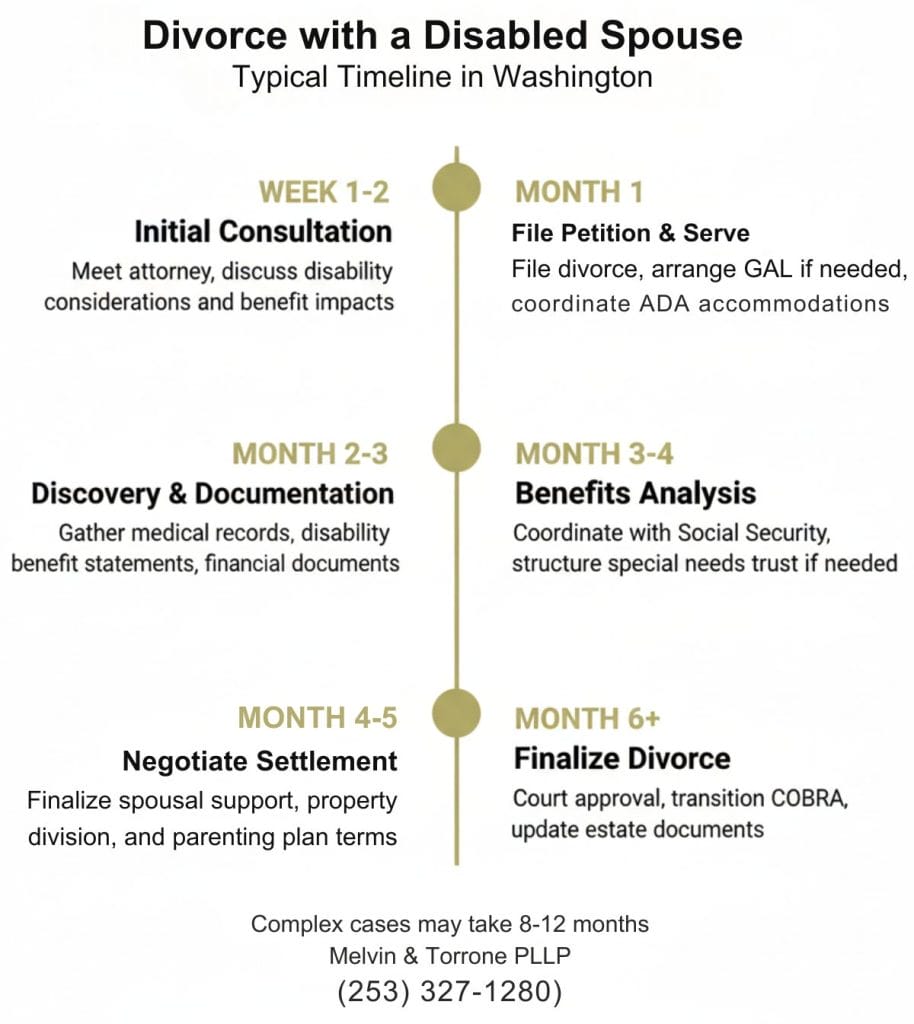
Washington requires 90 days minimum between filing and finalizing divorce, but disability adds months to this timeline. Gathering medical records, consulting with Social Security about benefit impacts, and structuring special needs trusts takes additional time. I tell clients to expect six months minimum when disability benefits and property division intersect, because rushing these cases creates expensive mistakes neither spouse can afford.
Creating Parenting Plans When Disability Affects Custody
How Washington Courts Assess Parenting Ability with Physical Disabilities
Washington judges focus on what you can do, not what you can’t. Courts examine whether disability prevents you from meeting your children’s basic needs like feeding, supervision, and emergency response. I’ve defended countless parents with mobility issues who proved their parenting ability through creative solutions like accessible playgrounds, support networks of family helpers, and adapted home environments that keep kids safe.
Modified Visitation Schedules for Parents with Health Limitations
Child custody arrangements flex around medical appointments, energy levels, and care requirements. Courts approve shorter but more frequent visits when chronic pain limits stamina, or schedule parenting time around dialysis treatments and therapy sessions.
A parent facing a serious illness like advanced cancer often fears that diagnosis alone means losing time with their children. In practice, a parenting plan can be built around good days and bad days, with a relative serving as backup during treatment that leaves the parent depleted. Arrangements like this protect the children’s relationship with an ill parent, and the other parent frequently supports them because they serve the kids’ best interests.
Safety Considerations and Supervised Parenting Time Options
When disability involves unpredictable symptoms like seizures, mental health crises, or medication side effects, courts may require supervised visits initially. This protects children during adjustment periods and builds trust through documented safe interactions. Pierce County offers professional supervision services, or judges approve responsible family members as monitors, creating pathways to unsupervised parenting time as stability improves.

Insurance and Healthcare Coverage After Divorcing a Disabled Spouse
COBRA Options That Last 36 Months for Disabled Former Spouses
Your disabled spouse gets 36 months of COBRA continuation coverage after divorce, triple the normal 18-month period for job loss. This extended protection costs the same premiums your employer charged during marriage, giving your spouse three years to transition to other coverage. I always build COBRA costs into spousal support calculations because these premiums often exceed what clients expect.
Transitioning from Private Insurance to Apple Health Programs
Apple Health enrollment opens immediately after divorce finalizes, but the application process takes weeks. We help clients time their divorce to minimize coverage gaps between COBRA and Medicaid approval. Smart transition planning addresses these critical insurance questions:
-
Which medical costs COBRA covers that Apple Health won’t
-
How to maintain relationships with current healthcare providers during the switch
-
Whether specialist care requires new referrals under Medicaid rules
-
What happens to prescription medication coverage during the transition period
Someone with a chronic condition like lupus may fear losing access to a specialist after divorce. Coordinating the COBRA election with the Apple Health application, confirming in advance that the specialist accepts Medicaid patients, and verifying that expensive medications such as biologics stay covered are the steps that keep care continuous through the insurance handoff. Timing these pieces together is what prevents a dangerous coverage gap.
Medicare Continuation and What Divorce Does Not Change
Medicare benefits through Social Security Disability Insurance continue regardless of marital status because they’re tied to work history, not marriage. If your spouse qualified for Medicare before retirement age due to disability, divorce doesn’t touch that coverage. Their dependent benefits through your work record might change, but their own Social Security Disability earned benefits remain completely protected.
When Divorcing Your Disabled Spouse Is the Right Decision
Recognizing Caregiver Burnout and Your Own Physical Limits
You’re not a bad person for admitting you can’t do this anymore. Caregiver burnout destroys your health, relationships, and mental wellbeing in ways people who haven’t lived it simply don’t grasp. I’ve sat across from exhausted spouses who developed their own medical conditions from years of lifting, sleepless nights, and constant worry about their partner’s care requirements.
Safety Concerns That Make Separation Necessary
Some disabilities involve unpredictable violence, substance abuse linked to pain management, or mental health symptoms that endanger you or your children. Staying married doesn’t make you safer when disability creates genuine danger. When a partner’s brain injury causes aggressive outbursts that frighten a child in the home, a spouse can love who their partner used to be and still refuse to sacrifice the family’s safety to guilt. In situations like this, a legal separation can be structured to fund the disabled spouse’s supervised care while protecting the other spouse’s custody rights and financial security.
How Timing of Disability Onset Affects Property Division
Disability before marriage often means separate property protections for assets you brought into the relationship. If disability developed during marriage, Washington treats everything as community property regardless of whose name appears on accounts. Courts examine whether you sacrificed career advancement to provide care, how medical costs depleted joint savings, and whether your spouse’s disability benefits should count as marital income when dividing assets fairly.

Estate Planning and Long-Term Financial Protection After Divorce
Updating Power of Attorney Documents Post-Divorce
Divorce doesn’t automatically revoke your power of attorney for your ex-spouse, creating dangerous situations if medical emergencies arise. You need new healthcare and financial POA documents immediately after divorce finalizes. I’ve seen cases where divorced spouses still controlled each other’s medical decisions years later because nobody updated the paperwork, leading to bitter conflicts when serious health crises hit.
How Housing Modifications and Accessibility Needs Factor Into Settlements
Courts consider who invested in wheelchair ramps, bathroom modifications, and specialty equipment when dividing the family home. If you spent $40,000 adapting your house for your spouse’s disability, judges often award you compensation through other assets or require your ex to reimburse modification costs. Here’s what Washington courts examine in accessibility disputes:
-
Who paid for permanent structural changes like widened doorways and roll-in showers
-
Whether the disabled spouse can realistically find comparable accessible housing
-
Moving costs and adaptation expenses for a new residence
-
Fair market value differences between accessible and standard homes
Imagine a couple who transformed their home into a fully accessible residence after one spouse’s degenerative diagnosis such as ALS. The other spouse may want to downsize but feel trapped by that investment. A settlement can be structured so the disabled spouse keeps the adapted home while the other spouse receives offsetting assets, such as a rental property and retirement accounts, giving both parties housing security without resentment over the accessibility improvements.
Planning for Long-Term Care Costs in Washington State
Nursing home care in Washington averages $10,000 monthly, and someone needs to address who pays these expenses post-divorce. Spousal support agreements should specify whether maintenance covers future institutional care or only current living expenses. Legal counsel helps you structure settlements that protect both parties from catastrophic long-term care costs draining assets meant for your own retirement or your children’s inheritance.
Melvin & Torrone PLLP Understands Complex Disability Divorces
Decades of Experience with Washington Family Law and CPS Cases
We’ve spent over two decades fighting for families in Pierce County courts, handling everything from CPS custody battles to the most complex disability divorce cases Washington throws at us. Our deep experience in divorce cases and knowledge of Washington’s maintenance statutes mean we anticipate problems before they derail your case. You’re getting legal counsel that knows every Pierce County judge, understands local court procedures, and has seen every disability scenario imaginable.
How We Protect Both Your Rights and Your Spouse’s Benefits
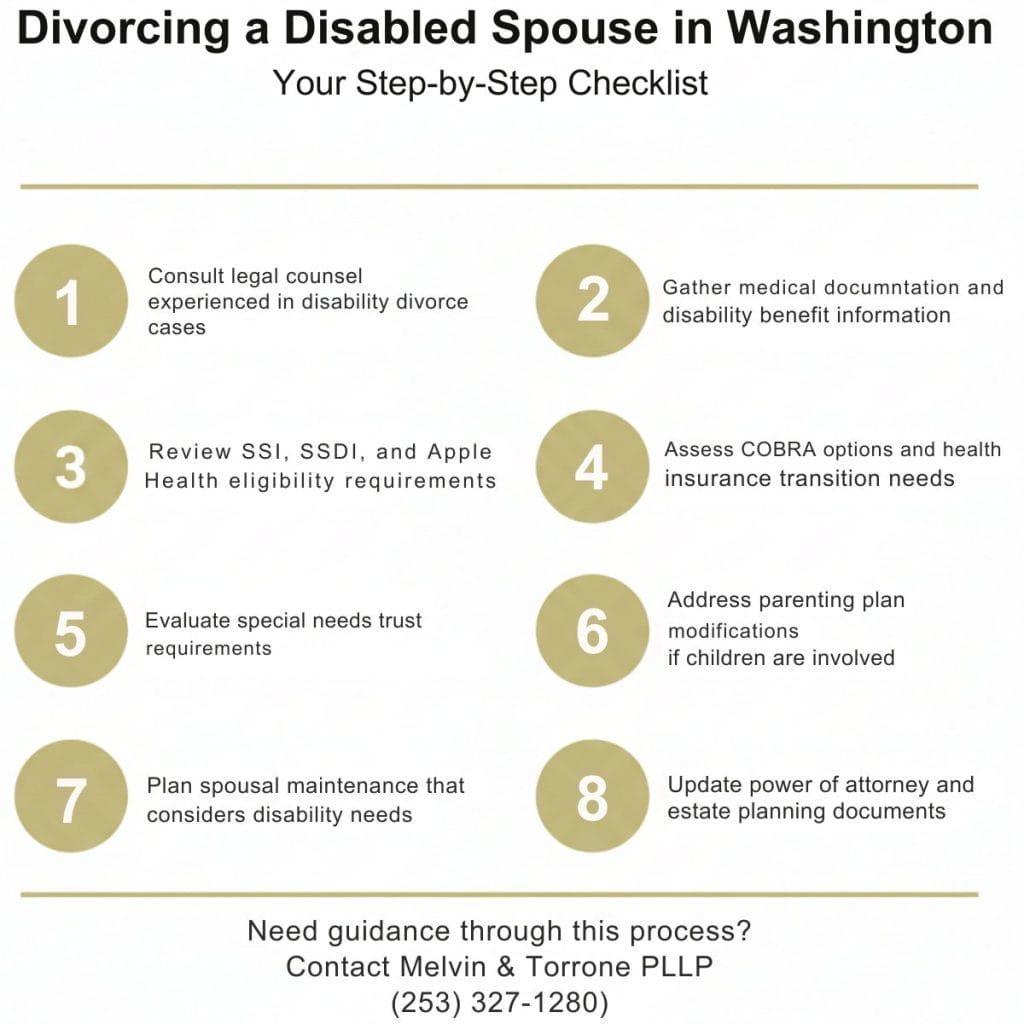
We coordinate with Social Security specialists, Medicaid planners, and disability advocates to structure settlements that don’t accidentally destroy your spouse’s benefits. Our approach protects you from unfair durational alimony while ensuring your ex-spouse maintains the compensation benefits and medical coverage they desperately need. Consider what we examine in every disability divorce:
-
How property settlements affect Supplemental Security Income eligibility thresholds
-
Whether spousal support calculations preserve Apple Health qualification
-
Timing divorce finalization to minimize insurance coverage gaps
-
Structuring special needs trusts that satisfy Washington community property laws
Some spouses are told their case is simply “too complicated” because a partner relies on benefits-dependent medical equipment, such as an insulin pump and continuous glucose monitor for diabetes. These cases are workable. By coordinating with the treating physician and a benefits specialist, a settlement can give the healthier spouse financial freedom while keeping the disabled spouse qualified for the state programs that cover essential equipment.
Compassionate Guidance Through Pierce County’s Most Difficult Divorces
This decision tears you apart, and we get that. I’ve walked hundreds of clients through the guilt, exhaustion, and fear that comes with divorcing someone you still care about but can no longer care for. We give you legal advice that’s both strategic and kind, explaining your options without judgment. You’ll be known by your name here, not a case number, and we’ll fight to protect your future without demonizing the spouse whose disability changed everything.
Frequently Asked Questions
1. How does Washington law protect disabled spouses during divorce?
RCW 26.09.090 requires courts to consider your spouse’s physical and emotional condition when calculating spousal support and property division. Washington judges often award longer maintenance periods and adjust asset splits to account for care requirements, medical costs, and limited earning capacity that disability creates.
2. What if my spouse can’t understand the divorce due to cognitive disability?
Pierce County courts appoint a guardian ad litem to represent your spouse’s interests and ensure fair treatment throughout proceedings. The GAL investigates your case, consults with healthcare providers, and recommends settlement terms that protect the disabled spouse who cannot advocate for themselves.
3. How long does divorcing a disabled spouse take in Washington State?
Expect minimum six months from filing to finalization, well beyond Washington’s standard 90-day waiting period. The extended timeline accounts for gathering medical documentation, coordinating with Social Security about benefit impacts, structuring special needs trusts, and ensuring settlements don’t accidentally destroy disability benefits.
4. Can spousal support be modified if my ex-spouse’s disability worsens?
Absolutely. Washington courts allow maintenance modifications when circumstances substantially change, including disability progression that increases care requirements or medical costs. You can petition Pierce County courts to adjust support obligations upward or downward based on documented changes in either party’s health or financial situation.
5. Will divorcing my disabled spouse make me look heartless to the judge?
No. Pierce County judges understand caregiver burnout, safety concerns, and the impossible emotional toll of caring for a disabled spouse. Courts focus on fair legal outcomes, not judging your personal decision to divorce, especially when you demonstrate concern for your spouse’s post-divorce financial security.
6. Does my disabled spouse lose health insurance immediately after divorce?
Not immediately. Your spouse qualifies for 36 months of COBRA continuation coverage after divorce finalizes, giving substantial time to transition to Apple Health or other programs. We help clients coordinate timing to prevent coverage gaps between COBRA and Medicaid approval, protecting continuous access to healthcare providers.
7. What happens to my spouse’s Social Security Disability benefits after we divorce?
Social Security Disability Insurance benefits remain completely unchanged because they’re based on work history, not marital status. Supplemental Security Income often improves after divorce since Washington counts only individual income for eligibility, potentially qualifying your ex-spouse for benefits marriage previously disqualified.
8. How does child support work when one parent receives VA disability benefits?
VA Disability Compensation counts as income for child support calculations in Washington, though courts consider the disabled parent’s actual ability to contribute to the custody of minor children. We work with veterans to structure support that covers medical expenses while protecting their VA disability benefits and ensuring fair health insurance coverage for kids.
9. What happens to my spouse’s medical bills and health coverage after divorce?
You’re not responsible for medical bills incurred after divorce finalizes, but divorce settlements often address existing medical debt division. Health coverage transitions through COBRA or collaborative divorce planning ensures your ex-spouse maintains access to medical care and health insurance coverage without dangerous gaps that could worsen their condition.
10. Can we use collaborative divorce when disability complicates our case?
Absolutely. Collaborative divorce works well for disability cases because it allows healthcare professionals and disability law experts to participate in settlement discussions. This approach provides emotional support for both divorcing parents while creating fair asset division that protects government benefits, addresses medical visits coordination, and preserves health care proxy arrangements where appropriate.
11. Are there support groups for spouses divorcing disabled partners in Pierce County?
Several support groups serve caregivers and divorcing parents facing these difficult decisions, offering emotional support without judgment. We connect clients with local resources that understand the unique challenges of balancing your own needs against disability care requirements, helping you process guilt while making sound decisions about your family’s future.
12. How do long-term disability insurance policies factor into divorce settlements?
Long-term disability insurance benefits and disability insurance policies are considered marital property subject to division in Washington divorce cases. Courts examine when the policy was purchased, who pays premiums, and how benefits support household expenses when determining fair asset division that protects both parties’ financial security post-divorce.
Conclusion
Divorcing a disabled spouse in Washington requires balancing legal strategy with genuine compassion for everyone involved. You need legal counsel who understands both Pierce County procedures and the emotional weight you’re carrying right now. We’ve helped countless families through these painful decisions with decades of combined experience. You deserve clarity about spousal support obligations, property division options, and how to protect disability benefits through this transition.
Let’s discuss your unique situation without judgment and create a plan that protects your future. Book a free consultation today.
Each case is unique. Past results do not guarantee future outcomes. This article provides legal information, not legal advice. Reading this article does not create an attorney-client relationship with Melvin & Torrone, PLLP.

Chris Torrone
Founding Partner, Melvin & Torrone PLLP
Chris Torrone is a dedicated advocate for clients facing family crises and criminal charges. With 20 years of experience practicing in Pierce County courts, Chris has built a reputation for meticulous case preparation and creative problem-solving in high-stakes litigation.